KINTSUGI AND THE ART OF COFFEE MUG MAINTENANCE
Cracked mug
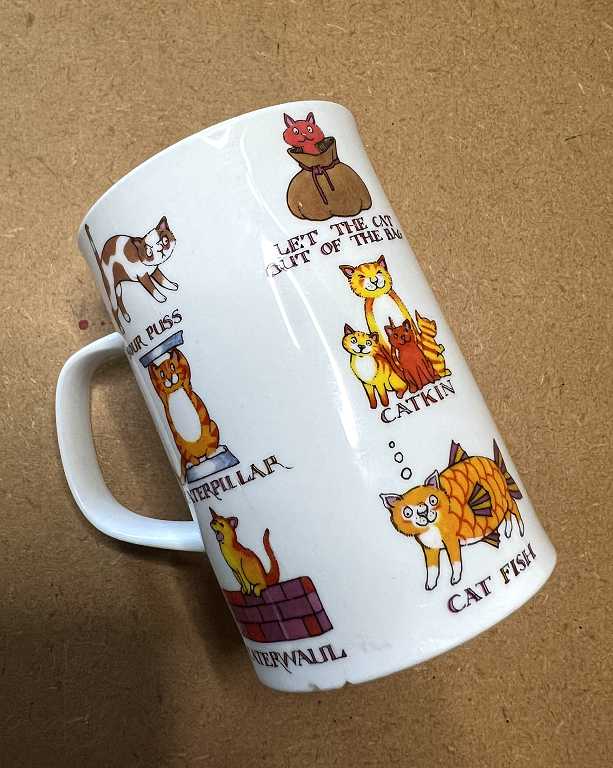
I was devastated recently to discover that my favourite mug had developed a crack, and was leaking. I was given this mug many years ago by a friend who knows I love cats, and I love all the fun kitty pictures on it. I use it every morning for my breakfast coffee, and nobody else is allowed to use it. Last year I managed to find another one on Ebay and bought it in case anything awful should happen to this precious mug, so I had a spare!
The mug sat in my studio for a few weeks while I tried to decide what to do about it. Repairing leaking pottery is quite difficult.
Kintsugi
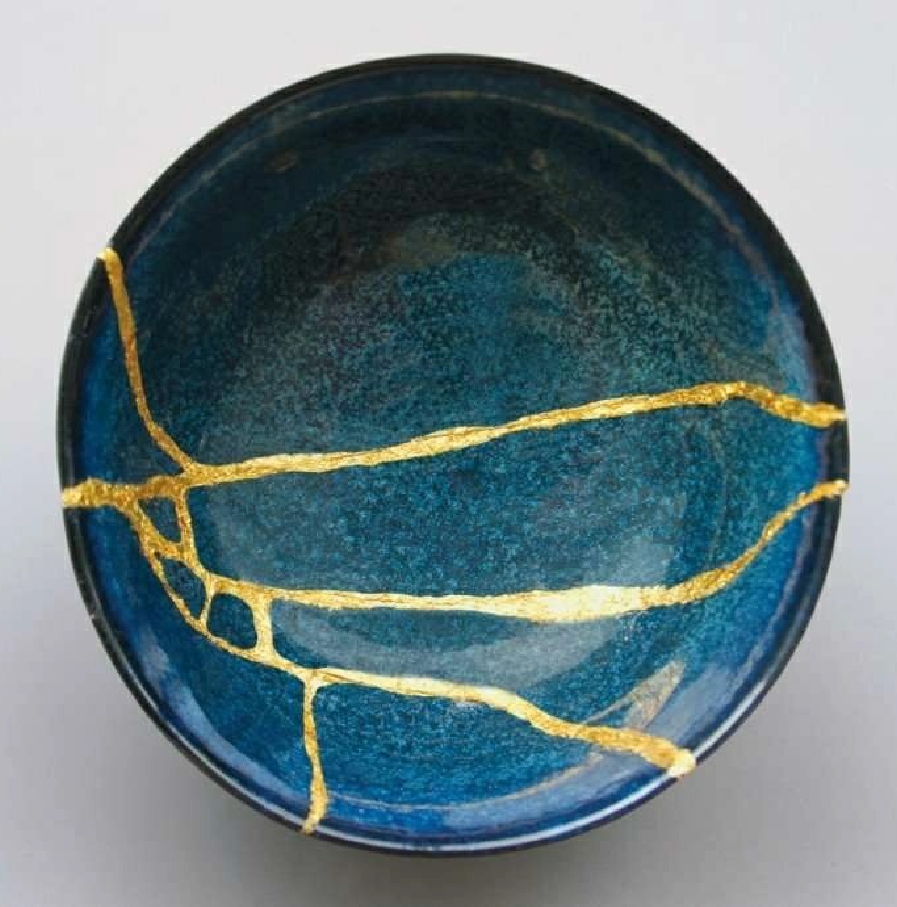
Then I remembered kintsugi. This ancient Japanese art is part of their wabi sabi philosophy – to celebrate the imperfect. They take broken pottery and repair it – with gold!
Here is a beautiful example.
Researching online, I found the traditional Japanese method to be pretty complicated, and involving the sap of a certain native tree, and more besides. However, there is a modern Western alternative which uses epoxy adhesive mixed with gold mica powder (or pure gold powder if you prefer). Epoxy adhesive is extremely strong and makes an excellent permanent bond on ceramics, which is waterproof and food safe.
Kintsugi kit
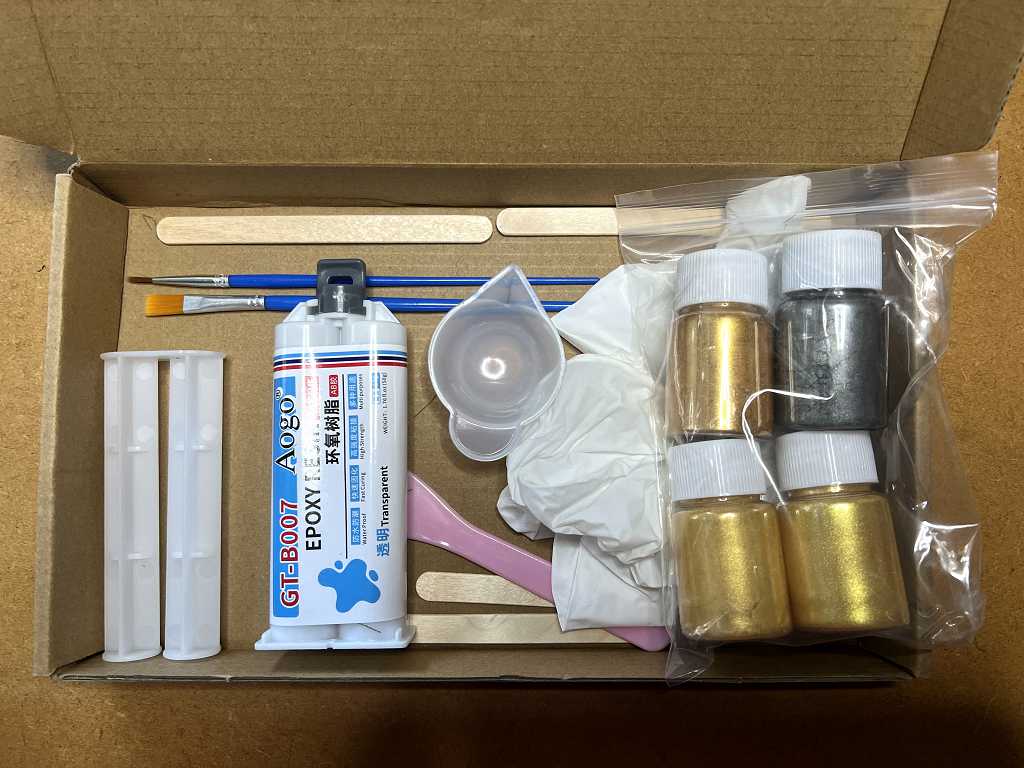
I found this kintsugi kit on Amazon. If I’d thought about it, I could probably have bought the elements separately and saved myself some money. I already have metallic mica powders and various spatulas, gloves and several small silicone mixing bowls, and of course paint brushes, but what’s done is done! It’s good to have a dual tube of epoxy adhesive, though, as I didn’t have any of this.
No instructions and a resulting mess
There were no instructions in the box, and very limited ones on Amazon. I therefore ploughed ahead and attempted to repair my mug.
I decided I could not do this repair if the mug was intact but cracked, so I wrapped it in a towel and bashed it with a rolling pin to break it. This practically broke my heart as well!! It came apart in several pieces.
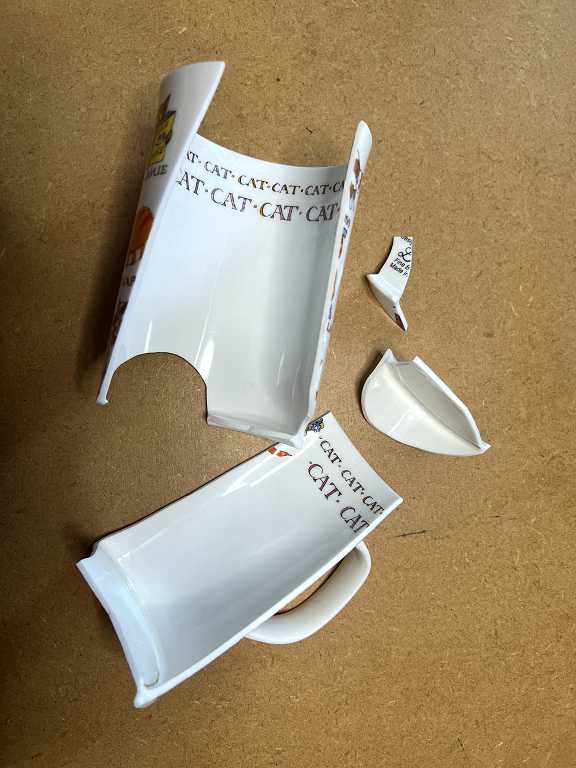
Beginning the repair
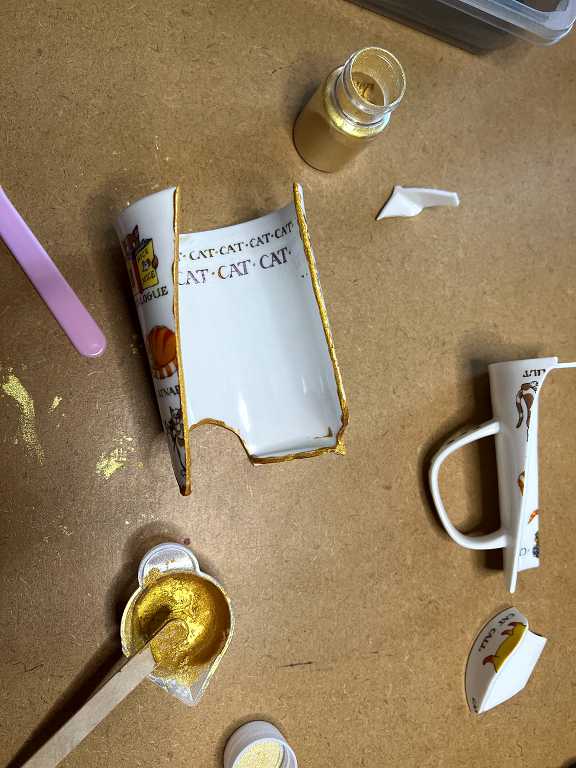
I mixed some of their gold mica powder into the bowl and spread it over the broken edge of the largest piece of mug. I neglected to protect my work surface and it is now unfortunately permanently stained with gold… Ah well, there are worse colours to be stained with, I suppose.
I attempted to stick it all together in one go. Epic fail. It kept falling apart and at one stage even managed to penetrate the glove and draw blood!! I thought this whole thing was going to be a complete waste of time with no result at all apart from a completely destroyed mug – I could have used it in its cracked state as an ornament – and a stained desk and cut finger!
However, I persevered and eventually the mug was reassembled, but there was gold epoxy all over the mug. What a complete mess. I didn’t photograph it at this stage.
The following day, the glue was completely cured. I wondered if I could clean it off. Further online research revealed that removing cured epoxy is “extremely difficult” and various noxious chemicals were involved! They also said that physical scraping might work. I found a small tool in a box where I keep Dad’s small tools – I think it is from a manicure set as it looks a bit like a cuticle pusher – it has a fairly thin edge but not sharp. Over a period of several hours I was able to remove all the dried glue from the mug with this, and then later I went over it all with the finest grit sandpaper in my stash to remove any slight gold bloom remaining. This is the result.
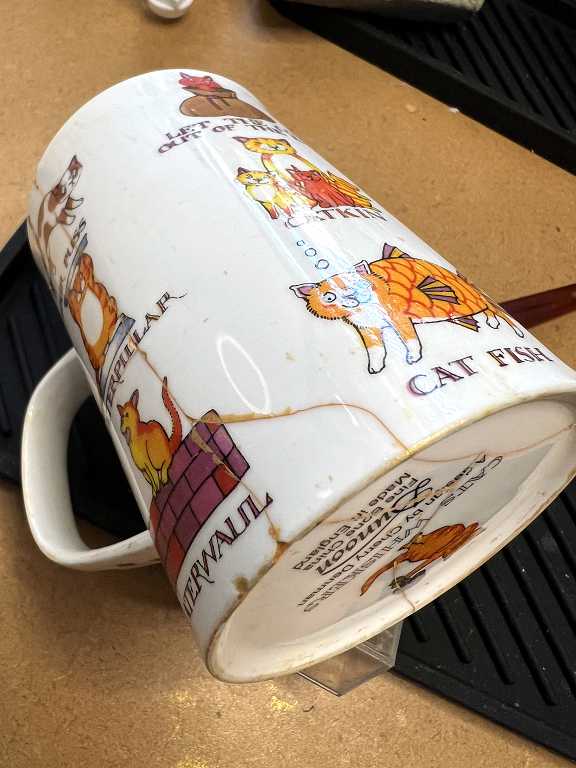
The mug was completely repaired and even “rings” when struck lightly on the side, showing that there are no more cracks. However, the gold was dull, and the lines not thick enough, and it just looked like a rather bad repair.
I told my hubby about all this and mentioned that there weren’t any instructions in the box. He said, “Aren’t there any YouTube videos telling you how to do this?” “Yes,” I replied, “But I only looked for them after I’d made the mess!” He laughed at me for being so stupid!!
A successful second layer
This time I mixed up some more expoxy with a little of my own much finer gold mica powder, and applied it carefully with a cocktail stick. While the glue was still soft, I sprinkled on more mica powder by dipping a very soft round brush into the powder and tapping it off onto the mug.
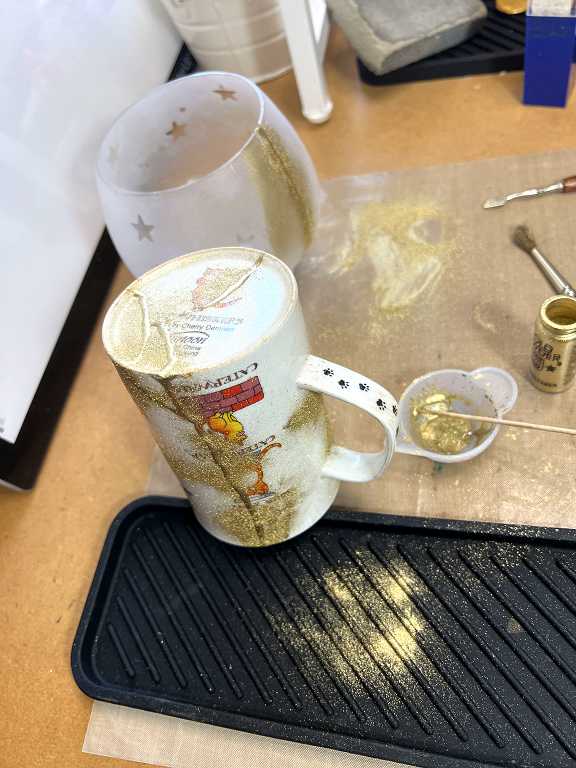
We went out for a couple of hours in the afternoon and when we returned, the glue was cured, and I was able to brush away the excess powder and also remove any further fine gold blooms on the mug with the fine sandpaper.
The finished mug
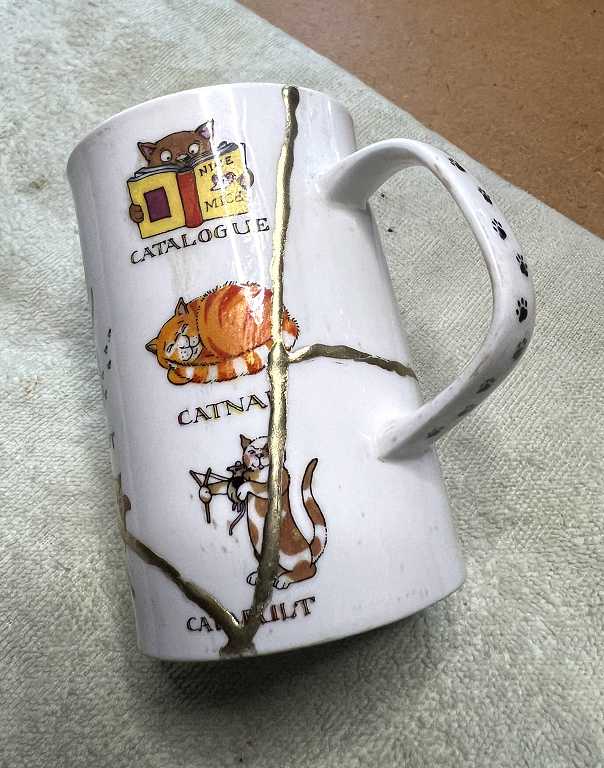
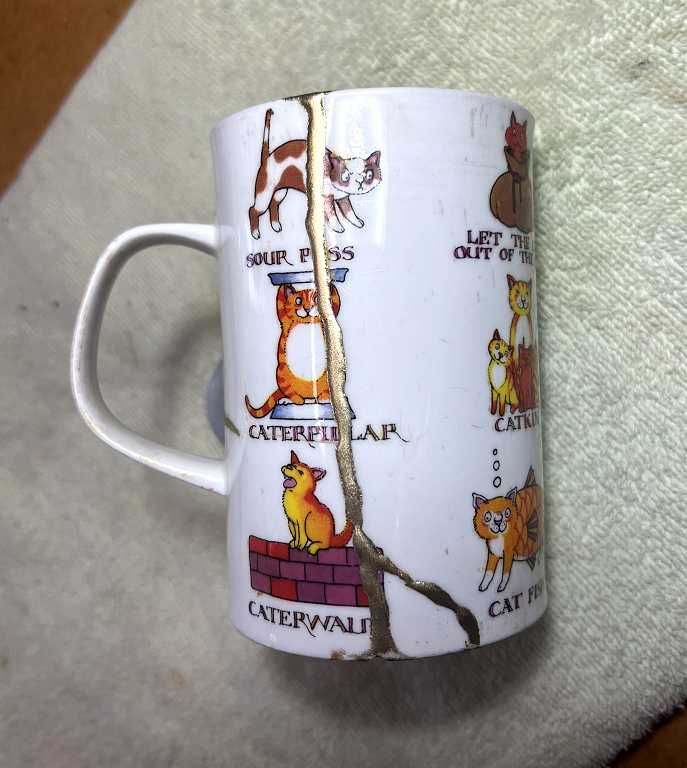
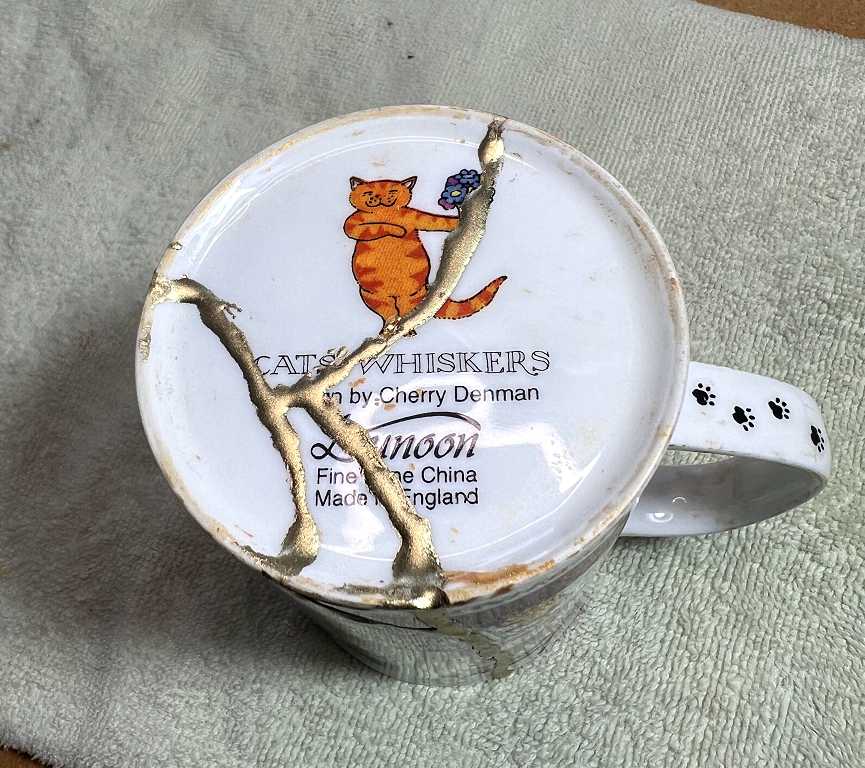
I am not displeased with the result. I do not intend to use it for drinking from, though, because even though they say it is food safe, I’m not really sure, and also it will be vulnerable in use, being washed, and having coffee in it. The inside of the mug is also a bit of a mess as it was impossible to tidy up and redo like the outside. The mug is now sitting on my dressing table as an ornament.
More kintsugi on a cracked glass candle holder
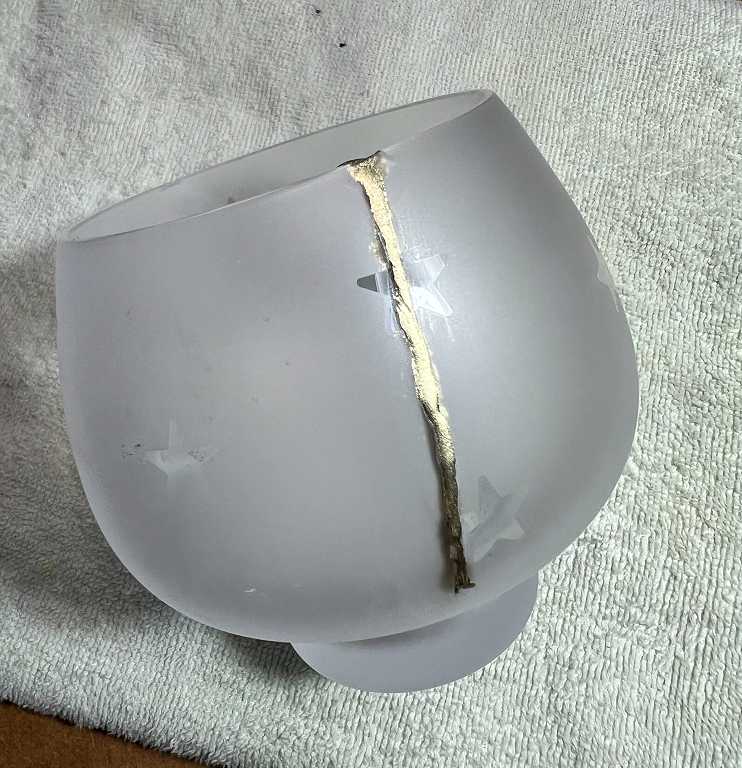
My lovely frosted glass candle holder that I was given when we first came here fell over and got cracked recently.
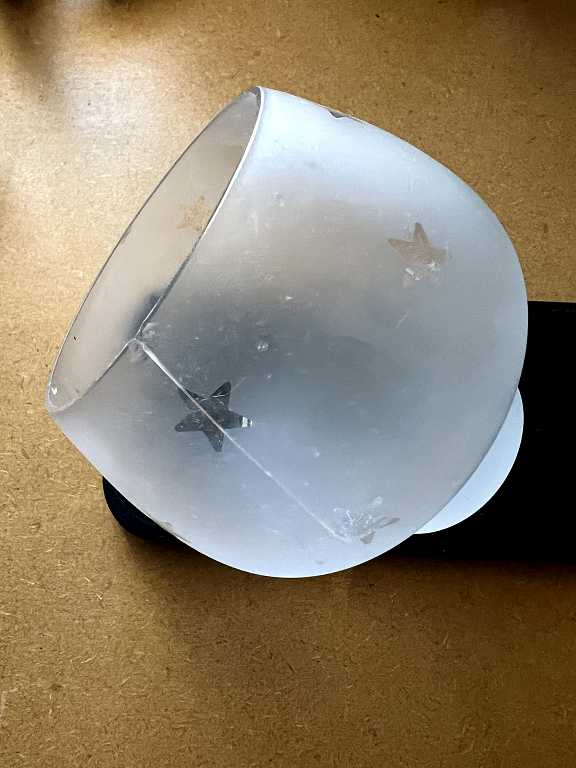
I have now filled with crack using the same method. I realised I didn’t have to break it and remake it. Being glass, I had to be sure that the inside repair was as close as possible to the outside one, or the difference would show through the glass. I managed to trim back a bit of excess and it’s pretty good now.
Further thoughts on kintsugi, life and art
If you’ve stayed with me thus far and are prepared for a little more, here are some thoughts on kintsugi and wabi sabi. I wrote a piece for my blog on the subject almost exactly three years ago, entitled “Celebrating the Imperfect,” which you can visit and read if you wish. Here are some exerpts.
“I had met a lovely young lady and discovered we had much in common with our health problems. We discussed the differing attitudes that people have, to what has been done to their bodies through numerous surgeries, and how beneficial a positive attitude is, not only for a good outcome and recovery, but also regarding one’s thoughts about body image. She had grown up angry and bitter about what had been done to her body and how difficult it was to deal with this, as well as with chronic illness, during those crucial teenage years where socialising is so important, and body image is everything – being different in this way, particularly when it relates to the bowel, is extremely embarrassing for young people. I am so grateful that I went through these experiences as a mature adult and was spared the anguish that this must cause a young person.
“I remembered a conversation I had with a lady having chemo alongside me back in 2015 and how I was able to challenge her “pity party” attitude to her stoma. It is not so much the things that happen to us in life that are important, but how we deal with them. The arrival of a stoma in your life is an unalterable fact, something you can do nothing about. You have to learn to live with it, and how you think about it will affect how it impacts your life. You can’t change the fact of its existence, but you can change your attitude towards it, and this makes all the difference to how you live your life subsequently. One of the nurses reported back to me afterwards that the woman had found my remarks helpful.
“My new friend and I agreed that in order of importance, what had helped us the most through our difficulties were faith in Jesus, a positive attitude, and a sense of humour – not to mention the support of a loving family. We also agreed that our “battle scars” are badges of victory, to be celebrated. My whole trunk is now a mess and were I to appear in a bikini I would probably clear the beach! However, I am not ashamed of it and know that each scar tells its own story and is part of the rich history of my various health problems and my triumph over them, and is a testimony to the fact that I am alive, I am still here, and I am still smiling. I am strong, I have been victorious. I can rejoice in the imperfections. Wabi-sabi.
“There is certainly something beautiful about the asymmetry and irregularity of much of Japanese art (think of Ikebana, their art of flower arranging), and I am also reminded of the beautiful art of Kintsugi where they repair broken pottery with gold, accentuating the flaws with something beautiful, rather than trying to hide them.
“Perhaps there’s a tie-in here with celebrating one’s battle scars from repeated surgeries! Fill ’em with gold and rejoice!
“This also brings to mind something really funny that happened to a friend of my hubby’s many years ago. His wife was cutting his hair for him. She was using an electric clipper and forgot to put on the guard that enables you to cut the hair to a predetermined length. She went straight up the back of his head with it and shaved a strip of hair right off! Not to be defeated, she grabbed a red pen and drew a line up the centre, and then took a black pen and drew in a series of Frankenstein’s monster-like stitches! Make a mistake? Don’t cover it up – make a feature of it!!
“This is also a good motto for mixed media artists, along with ‘in mixed media, there are no mistakes, only more layers.’
“I have always thought that portraits, in whatever form, of people with imperfections, are a lot more interesting than those of people with perfect features. It is a very sad feature of our times that many people are so dissatisfied with the self-perceived imperfections of their bodies that they submit themselves to the rigours and dangers of plastic surgery. The result can be grotesque, in my opinion, and at best, we are seeing ranks of individuals who look the same, more like Barbie dolls than human beings, and with their unique individuality obliterated. The infinite variety of human beings is something to be celebrated, to my way of thinking. I have come to learn over the years that outer beauty is meaningless in the greater scheme of things; inner beauty, integrity, honesty and strength of character are far more important. When people form relationships and marry on the basis of physical appearance, their relationship can end up as shallow and without real foundation as the physical beauty, which fades with the years in any case.
“I am reminded of the incredible artist Alison Lapper, who was born without arms and shortened legs. She was the subject of a piece sculpted by Marc Quinn, which was exhibited on the fourth plinth in Trafalgar Square in London in the early 2000s. Many people found the piece shocking as it showed Alison naked and pregnant.
“Quinn pointed out that classical Greek sculptures with missing arms through damage are considered beautiful, and he was showing that a sculpture depicting a subject missing arms naturally was also an object of beauty – it was all very thought-provoking regarding both art and disability. Rejoicing in the imperfections. Wabi-Sabi.
“So go on, embrace life’s imperfections and fill them with gold.”