JUNK JOURNAL – MAKE A JOYFUL NOISE PART 1
My first true junk journal!
I really don’t like the term “junk journal” but I’m sticking with it for this project because everybody recognises what a junk journal is. I would much rather call it an album made from recycled materials but it doesn’t have quite the same ring to it. Also, I do not make journals because I don’t journal! I make albums – books with different interactive elements, sometimes on a theme, and featuring mixed media materials, some printables, some individual art work – I do not specialise in anything really. Just what takes my fancy. My albums usually end up with a fairly uniform appearance as I prefer my pages to be the same size. Occasionally I may decrease the sizes of the pages towards the centre of the signature for a visual effect, but it is usually done in a symmetrical fashion. The plan for this book is much more along the normal junk journal route with randomly-sized pages. This is the first time I’ve attempted anything like this and it does tend to go against my somewhat over-ordered brain!
Sounds
One of the things that fascinates me about many of the journals I see being made online is the sounds they make as you turn the pages. Recently I’ve come across something I’d never heard of before (more later) which has made me more determined than ever to put a new idea into practice.
Widening the concept of mixed media
Why should mixed media art only include different art materials? Can we not spread the net further? Occasionally I come across people who add smells to their books but I’m not keen on that, especially as I suffer from minor chemical sensitivity and tend to avoid synthetic fragrances. I don’t mind the smell of coffee-dyed paper, though, and the smell does fade over time.
Exploring the senses in art
My dad had an artist/musician friend with synesthesia – a condition where one sensation will spill over into another. When she hears music, she sees colours. She does incredible abstract paintings based on various classical pieces and would always print one for her annual Christmas card. I wish I’d manage to rescue one or two before Dad passed as they were most interesting. Her name is Jane Mackay and you can find her online in the usual places. I was thrilled, through my recent researches for this project, to catch up with her again.
You can search online for “sound art” where people depict sound in the visual arts, and it’s a fascinating subject. John Cage was a 20th-Century American experimental composer who came up with some extraordinary cross-disciplinary pieces, his most famous being “Four Minutes and Thirty-Three Seconds,” during which the orchestra remained completely silent for that period. He was fascinated by the opposites of sound and silence and was influenced by his Zen Buddhism.
I haven’t come across anyone making a book specifically to focus on sounds, so this is my plan. Time to take the whole concept of “mixed media” to another level, perhaps!
ASMR
This seems to be taking YouTube by storm at the moment. It stands for Autonomous Sensory Meridian Response. This is what Wikipedia has to say about it.
“An autonomous sensory meridian response (ASMR) is a tingling sensation that usually begins on the scalp and moves down the back of the neck and upper spine. A pleasant form of paresthesia, it has been compared with auditory-tactile synesthesia and may overlap with frisson [pleasurable tingles and goose-bumps]. ASMR is a subjective experience of ‘low-grade euphoria’ characterized by ‘a combination of positive feelings and a distinct static-like tingling sensation on the skin.’ It is most commonly triggered by specific auditory stimuli, and less commonly by intentional attention control and visual stimuli.
“The term ASMR can also refer to media (usually audiovisual) meant to evoke this phenomenon, with the sensation itself being informally referred to as ‘tingles.'”
There are hundreds of YouTube videos, many of which are AI-generated, of weird things like cutting glass fruit, and one of my favourites was a selection of surreal books whose pages were made of such things as rock, slime, glass and sand, each one making different sounds as the pages were turned. The sound is quite intense, and while I haven’t experienced the expected “tingle,” it is rather pleasing to listen to. Other people generate the effect with whispered speech, intensified by the close proximity of the microphone, but I do not like this effect. The ASMR effect is enhanced with headphones, particularly those videos recorded with binaural microphones.
I’ve noticed people using the effect in their craft demonstration videos too, notably Natasha of Treasure Books, who has recently started introducing her videos with a quick flip-through of what she is going to demonstrate, with exaggerated sound effects. I tried to contact her to ask her how she does this but so far she has not replied, but it doesn’t matter now because I think she’s using ASMR techniques. This new feature in her videos was the main trigger for my idea of producing a book dedicated to sounds.
When I first tried to find out for myself how to do this, it was quite frustrating and lacked any results, because I didn’t know the correct terms to search for. Eventually I came across ASMR and realised that this was what people were doing. I did try to get some of the effect in a short video I made about the large album featuring my complete DrawAwesome course work. In my video editor I bumped the volume up as high as I could and got something of the effect, but there was obviously more to it that this.
Instructions are hard to come by. When you search, most of what you get is finished results, and as fascinating as these are, they are not very helpful. Some videos concentrate of the acquisition of a lot of expensive audio equipment and I am certainly not prepared to go down that route, although I have ordered an entry-level microphone from Amazon which has mostly excellent reviews, to try this technique, and for general use. I have found that the sound quality on some of my previous videos has not been that great with the phone microphone and hope that this will be a lot better. For AMSR, people are saying that you need to put a microphone very close to the source of the sound, but just out of the view of the camera. Phone microphones would not be adequate apparently.
All this is by way of preamble…
The start of my junk journal
I have had a couple of large metallic-finish plastic bubble-wrap envelopes for ages and thought they could be used for something. I recently saw a YouTube video where someone was using Amazon ones for junk journal covers and they made a gorgeous sound and thought I must try this! I’ve had a number of the Amazon ones in the past, which I’ve unfortunately thrown away.
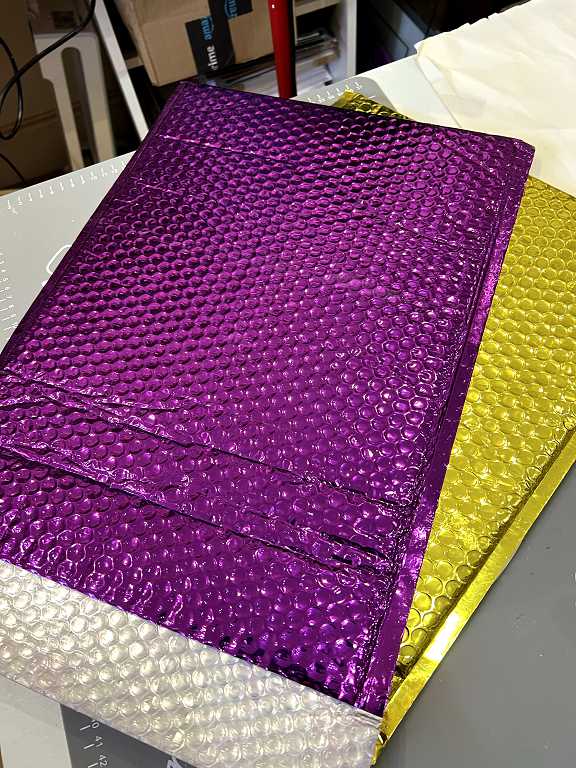
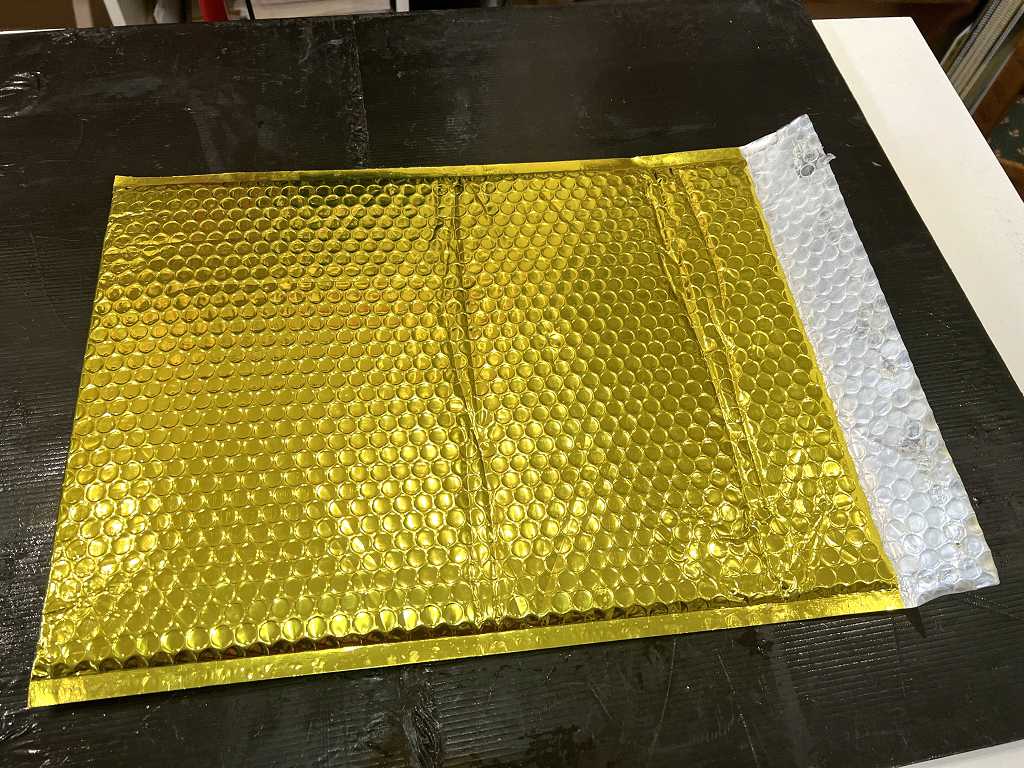
The gold one is slightly larger, so I’ve decided to use this one. I am keeping the flap which will act as a closure. These envelopes aren’t quite as noisy as the more papery plastic Amazon ones but good enough for now.
Covering the front
I have wrapped one side of this envelope with brown packaging paper, glueing it around onto the inside.
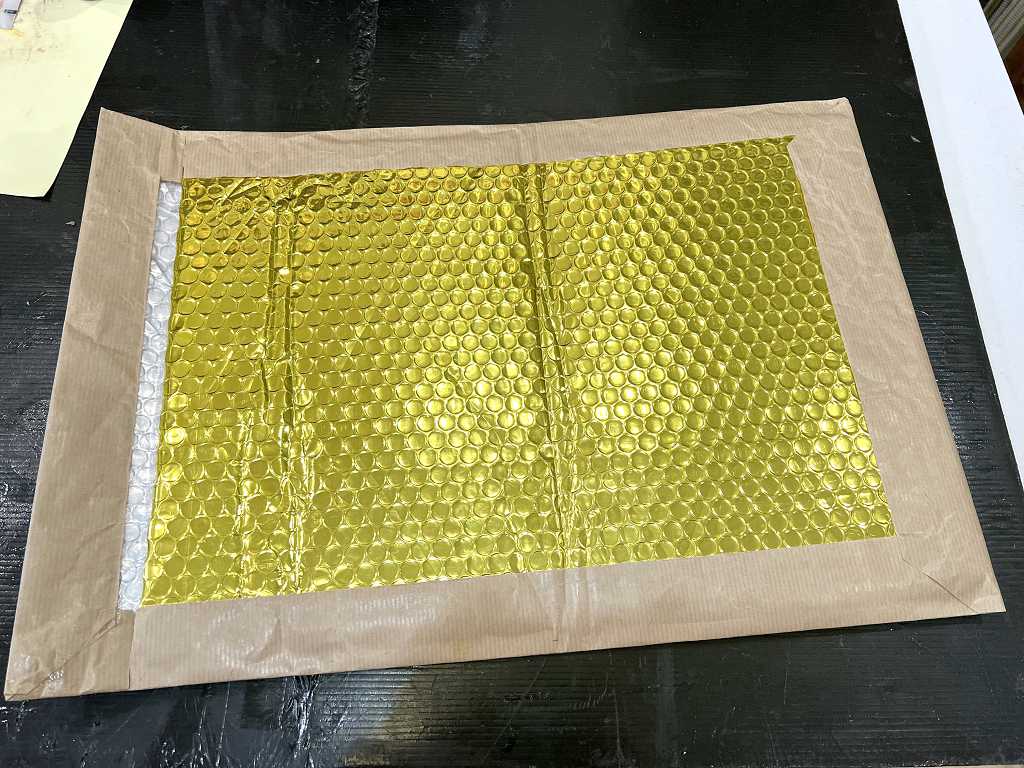
I covered part of the flap as well. I shan’t be covering the inside until I have decided on the order of the pages and how the signature will be arranged. I am planning on keeping this as a single-signature album but may increase this to two if it becomes too thick. The inside of the front cover, where the envelope opening is, will be a large pocket.
Selecting the papers for the pages
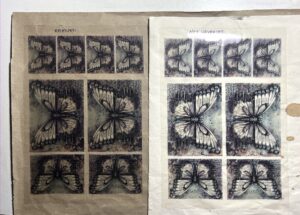
This is going to be a very rough and grungey album. Over the past few weeks I have been saving various papers which make different crackly noises as you handle them, and also some transparent and translucent sheets with different sound qualities. In this picture you can see the piece of stencilled vellum I made for my recent Infusions album, which was a disaster, and which buckled quite badly when I tried to flatten it by spritzing it with water. It has become extremely crackly and I really like the stencilled design on it. I knew it would come in for something so I’m glad I didn’t bin it! I have embellished the larger piece of brown paper with stamping, using one of my DIY foam stamps and black acrylic paint. This paper is very thick and has a deep-toned crackly noise.
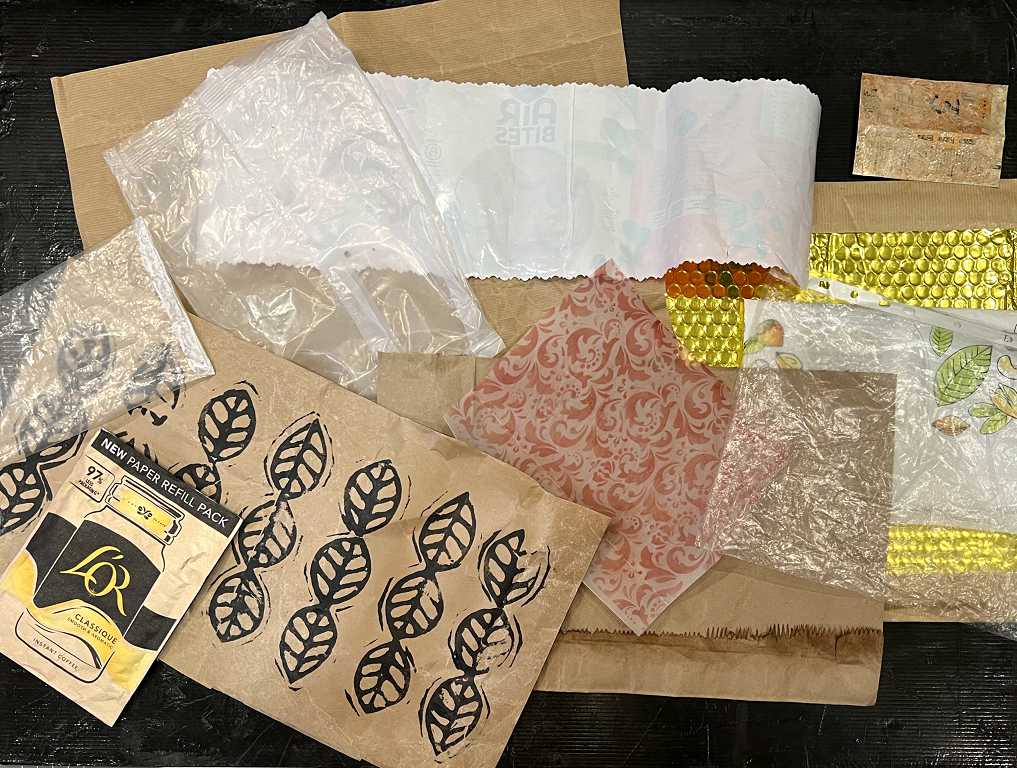
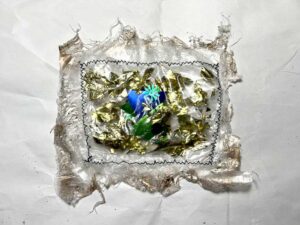
The coffee bag on top of it is extremely crackly! There’s a small transparent plastic piece above which I’ve folded and glued closed at one end, either to form a page or perhaps a pocket. It has a soft rustle, and would most likely be suitable as a shaker with various sequins inserted and sealed inside. The plastic bag on top is a cereal box liner which is also pretty crackly. I may heat-fuse this and see if it gets cracklier (is that a word? Well, it is now…) and I have a box of these so shan’t worry if that doesn’t work. You can fuse cereal box liners, sandwiching other stuff between the layers, which is very effective. The white piece at the top, which I have cut with fancy scissors, is another crinkly plastic bag with printing on the other side. It’s really hard to paint this very shiny stuff. I may end up simply glueing images onto it but that might destroy the sound element. The tiny piece at top right is another crinkly plastic piece which I painted with gesso and then gold paint, but it isn’t adhering well to the very slippery surface, despite having sanded it before painting. The bag with the leaves on it is from my wholefoods supplier. Their bags all have a leaf-shaped clear window in them and I thought I could make use of this somehow. The brown paper bag underneath had an interesting cut edge folded up at the bottom, so I put a piece of scrap paper underneath and added some ink to bring out this feature. I particularly like it because it has not been cut straight but has a random look about it.
Noise makers
I have been collecting a few things which would add some sounds to the book, including the lid of a jar with one of those security buttons on top. When you press it, it makes a very satisfying click as it goes up and down. I cut one out of a smaller jar but on its own it doesn’t make such a good sound. It works best on a hard surface, and needs some space beneath it to amplify the sound, so the sides of the lid will need to remain, making it pretty thick. I have also cut some narrow strips of acetate and coloured them lightly with alcohol ink. I stuck them together at one end but unfortunately this didn’t work, so they will need to be attached to the page with a brad or an eyelet. The idea is to lift them up and allow them to slap back onto the page, making a satisfying sound. Then I have bits of plastic packaging which are good noise makers if you run our fingernail over them. I want dangles with beads on them, and maybe a bell or two – anything to make an impact sound on a page or the cover. Velcro and magnets make interesting sounds as you activate them. There are many surfaces such as corrugated cardboard, metal or plastic grilles, combs and so on, which make lovely sounds as you run your fingernail over them. I think it would be fun also to have some elastic or rubber bands stretched across a stiff page, which could be plucked.
So I have plenty of ideas. I have to decide on the structure of the book with the signature(s) and how best to utilise the transparent and translucent sheets. I shall need to make some pockets and tags, and maybe some fold-outs, and add images to embellish the whole thing.
It will be a messy, grungey, brown sort of book with lots of irregularity and chaos about it, to match the cacophony of sound I’m hoping to create! This madcap idea may turn out to be a total flop. It’s all experimental and above all, fun.
Watch this space.