COLLAGE PAPERS FROM OLD FINANCIAL DOCUMENTS
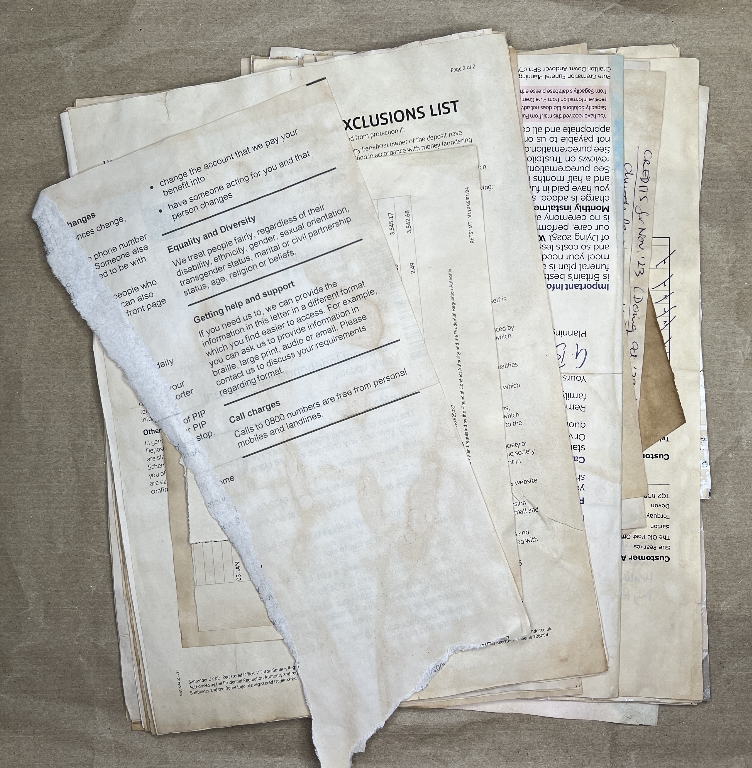
I have a large stack of old letters from the bank, statements, council tax bills and what not. I used to shred all this stuff, but some time ago I began tea and coffee dying them with the intention of turning them into useable art papers. As long as any personal or confidential data are obliterated, they are fine – when some text emerges through the media, it just adds depth and texture. I am not likely to come to the end of the pile any time soon, and it’s always being added to anyway, despite the promise that computers would lead us into the era of the paperless office!
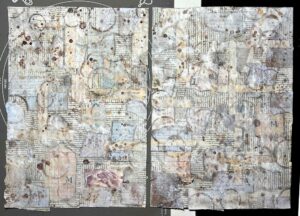
I made six yesterday, three stencilled and three stamped.
Preparation
To obliterate anything sensitive, I painted roughly over the whole surface with white gesso, and when this dried, some of the original text was showing through. Once they were almost dry, I sprayed them with some more coffee as I prefer the vintage look. Then it was time to decorate them. I began by spattering the papers, varying between diluted white acrylic paint, coffee, rust water and Payne’s grey water (water with some Payne’s grey acrylic paint mixed in).
Stencilled papers
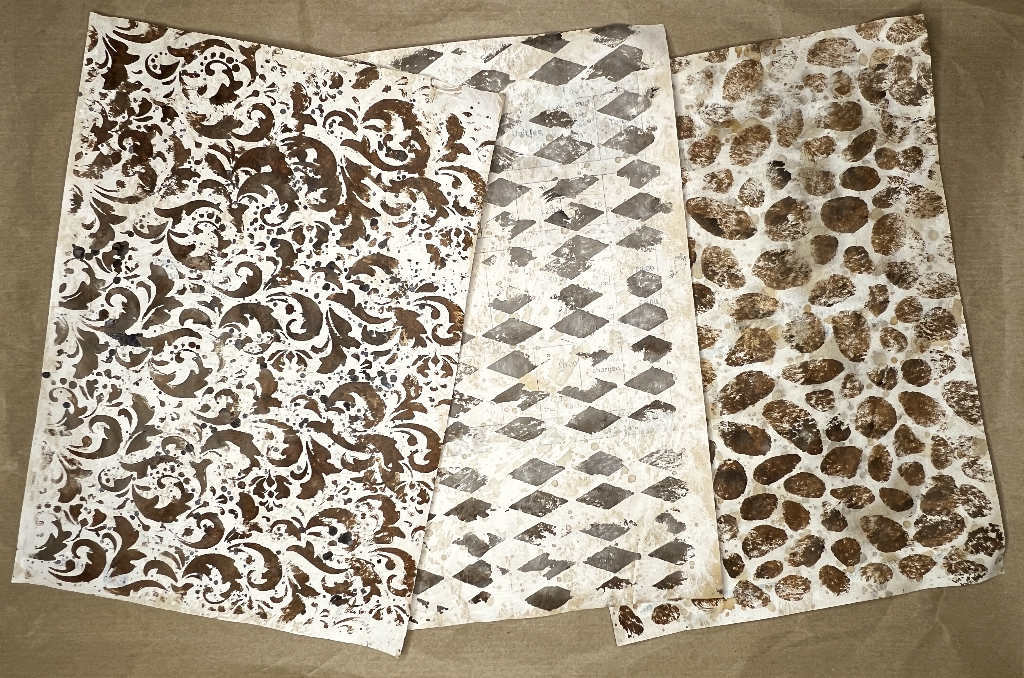
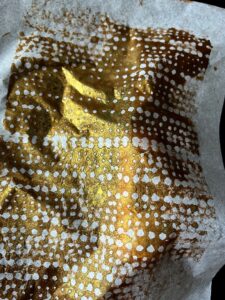
A combination of stencils, the first being the unbranded large almost A4-sized swirls stencil. The second one is from a set of tag-shaped stencils, also unbranded, with a distressed harlequin-diamond design which I love. Some of the diamond shapes have been cut as incomplete shapes which adds to the grunginess, but one can achieve this effect with a “perfect” stencil simply by not applying the paint completely. The third stencil is my own design, “Pebbles” which I cut from Tyvek. This breathable synthetic material is used in the building trade to control moisture. It is extremely tough and you cannot tear it, but it cuts like butter with scissors, a blade or with the cutting machine. I designed a series of stencils in Inkscape (open-source, free vector drawing software) and cut them with my cutting machine. The material is a bit too thin and floppy for complete ease of use, but I think with the build-up of some acrylic paint they should feel more sturdy. They work very well, though. You can see in this example that I deliberately didn’t apply the paint in a complete and neat and tidy way, but left some areas where it is mottled. These were all done with a mixture of acrylic paints in couple of browns and black, mixed incompletely on the palette.
Stamped papers
I decided to use some of my new stamp sets for these. I have a growing collection of Stampers Anonymous stamps by Tim Holtz, acquired over several years. Tim’s stuff is pretty expensive and it’s my main art indulgence, justified in my own mind by the fact that a lot of my art is made from completely free stuff that would otherwise find its way into the recycle bin! His stamp designs are produced by Stampers Anonymous, his dies and embossing folders by Sizzix, his inks by Ranger and tools and equipment by Tonic Studios, and they are all excellent quality, and he doesn’t seem to retire his designs either, which is a huge bonus. Far too many companies, especially those producing decorative papers, do this regularly, and you watch a YouTube video using them and try to find them, only to find that they are no longer available. I have some really old Tim Holtz stamps and I’m always glad to see that they are all still available to purchase.
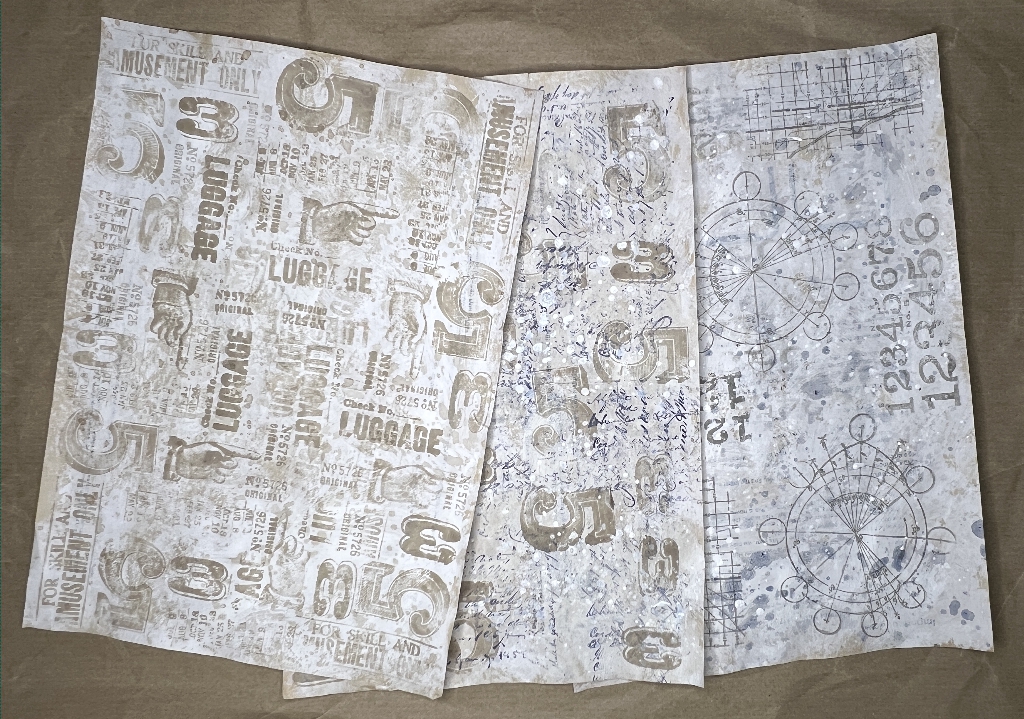
All these papers were stamped randomly, using Ranger Archival Inks. These ink pads are pigment ink, permanent and waterproof when dry, so excellent for mixed media work and layering. For the brown stamping I used Pebble Beach, and for the grey one, Watering Can. The centre one also has some script stamping in Cobalt. I love these subtle neutral shades.
Stamps
All by Tim Holtz. The blue script ones are a set of two, simply called “Script.” This is a very old stamp set, and possibly the first I bought. Other stamps on that sheet are from his sets “Ledger,” and “Eccentric.” The other brown sheet is stamped with stamps from “Eccentric.” The grey stamping is from his set “Deconstructed,” which is my most recent acquisition. These later sets have many stamps from which to choose.
Ghosting
This is the effect you get from not recharging the stamp with ink from the pad each time you stamp, but continuing to press the stamp to the page until the ink fades. You therefore get a series of ghosted impressions which, on the finished page, look as if they are fading into the distance, which gives a lovely sense of layered depth. In several places I have deliberately overlapped the stamps which adds to the effect.
Stamping without a block
The original rubber stamps for craft and card making etc. were mounted on wooden blocks for ease of use. A large collection would take up a lot of room. Nowadays they either come in the form of cling-mount rubber, or clear photopolymer. This has the advantage of much more efficient storage as they are quite thin and usually come mounted on a fairly stiff sheet of acetate in a clear pouch. The traditional way to use these modern stamps is to mount them temporarily onto an acrylic block which acts like the old wooden blocks – they adhere naturally and can be peeled off easily when you’ve finished using them. This gives a good clear impression. However, what many people (myself included) want to achieve these days is far from a clear impression, but a worn, vintage and grungey look. The way to achieve this is to use the flexible stamp without the block, and not being that careful about getting a clear impression simply pressing with one’s fingers.
Collage paper
All these papers are made using standard printer paper used for commercial correspondence, A4-sized. This paper is not robust for mixed media work but it is amazing how much stronger it becomes with only one layer of gesso. As you add more media, they become stronger still. They make reasonable album pages especially with the addition of further decoration in the form of pockets etc., and can be cut up for collage too. Very versatile. Nobody would have a clue that they were once red demands for payment or a jail sentence would ensue; statements that your investments were in good health, or information on how your local council is spending your money on not emptying your bins and funding things to which nobody in their right mind would consent, given the choice! It gives me great satisfaction to put these mundane and usually utterly dull pieces of correspondence to a much more interesting use. Turn the boring necessities of modern life into Art!!