ALL MY GOLDS
Sorry, Mr. Shakespeare – “All that glisters IS gold” – at least in Shoshi’s book!
A friend recently asked me about what gold I like to use in my art, and rather than just replying, I thought I’d do a post about it because it might be of interest or helpful to others. I have a lot of different gold paints and pens and tend to use them for different things or according to how the mood takes me.
I made this swatch of most of them – it was only after I finished that I remembered about Perfect Pearls and gilding wax (see later).
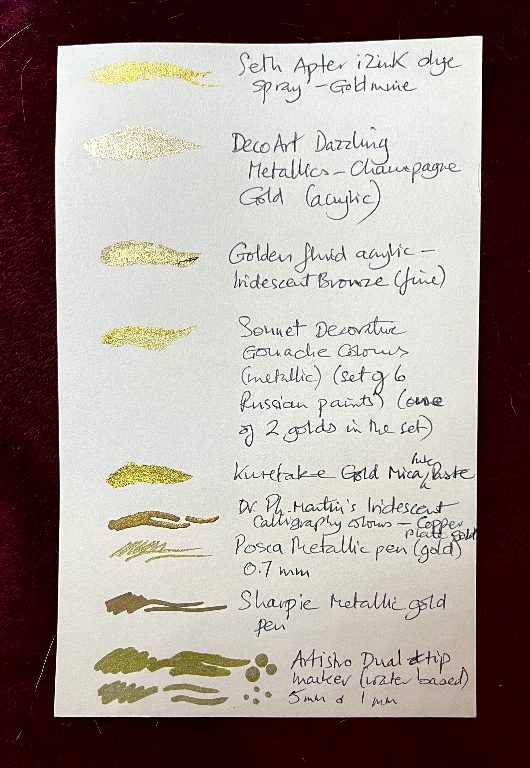
As usual, it is hard to photograph shiny, glittery or reflective stuff accurately but I’ve done my best. In real life everything looks better. I shall go through each one and give examples of projects where I have used them, which might show them better than in the swatch.
I can’t tell you where I got these – some have been in my stash for a long time, but mostly I think they were from Amazon or Ebay. A search online should find most of them.
Any liquid gold pigments such as spray inks, calligraphy inks etc., need to be shaken well before use, because the mica will sink to the bottom. Some bottles have a mixing ball in them and you need to be able to hear this rattling as you shake, to be sure that it is doing its job and not embedded in a solid mass of mica at the bottom of the bottle. Keep shaking well, and shake between applications on the current project!
Seth Apter iZink Dye Spray – Gold Mine
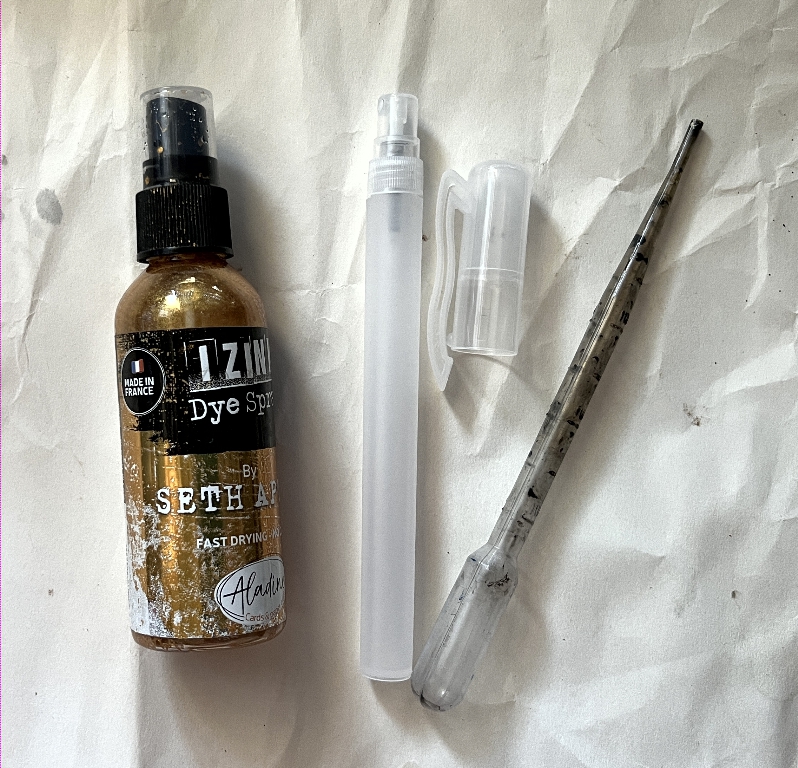
This is a fabulous intense gold spray ink. However, there are several drawbacks which involve a bit of extra work. I am now on my second bottle of this, having got a replacement from the seller because the first bottle’s spray became clogged. I tried everything to clean it, without success. The replacement went the same way. The bottle says it’s clog-free but this is not the case! What I do now is to remove the spray mechanism and draw up a little ink with a plastic pipette and squirt this into a mini-mister (both these tools are readily available online). The mini-mister doesn’t hold much and I usually use all of it in one project, but if there’s any left, I just pour it back into the bottle.
You can also remove the spray mechanism and use the end of the tube to spatter ink onto your project.
The other problem I have discovered with this ink is that when it is dry, it rubs off. Nobody mentions this and it made me wonder if it was a problem with the substrate. Anyway, the problem is remedied by spraying it with fixative.
An example of the ink in use
This is my most dramatic example. I was using some punched paper as a stencil, spraying the ink through onto some paper underneath, which gave me the stencilled result as well as the actual stencil piece. There was a lot of ink on the stencil piece so while it was wet I blotted it off onto another sheet, giving me a third result. This is the blot-off sheet.
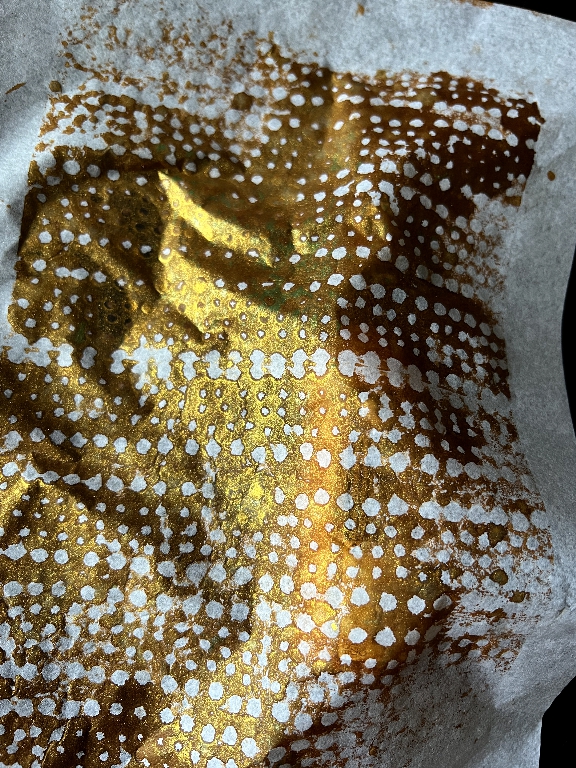
You can see how rich and intense this gold ink is. I am sure you could also paint with it but I haven’t tried this.
DecoArt Dazzling Metallics – Champagne Gold (acrylic paint)
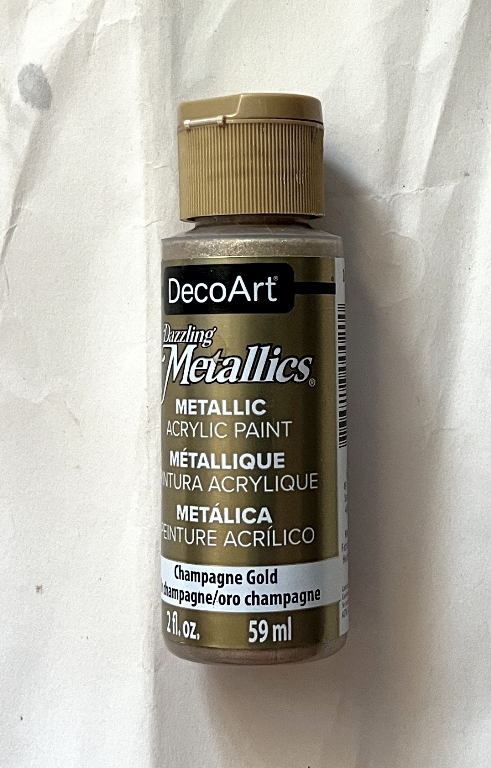
This is a gorgeous light gold paint. You can paint with it, stencil with it, or use it on the gel plate. Any way you can think of to use acrylic paints. This paint is fairly fluid.
Example
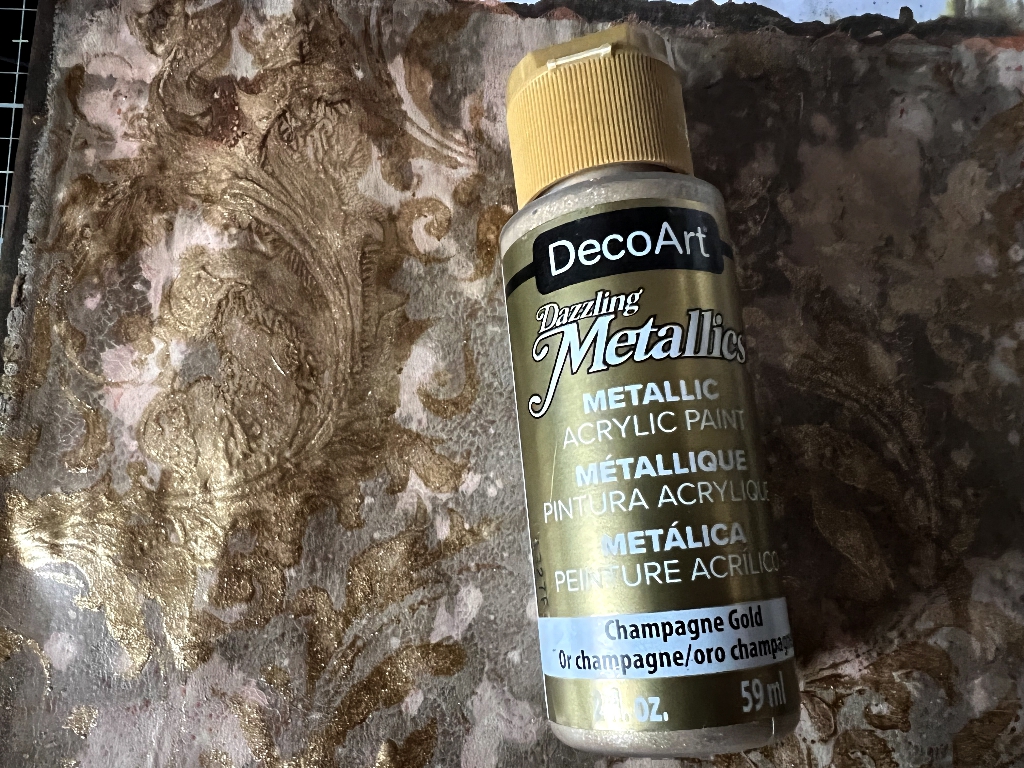
In this case I used it to stencil over an “old wall” gel print. Very vintage and distressed look.
Golden Fluid Acrylic – Iridescent Bronze (fine)
I think this has to be my favourite gold medium. It is also the most expensive. Golden is not a cheap brand, and you certainly get what you pay for – their paints are highly pigmented and absolutely gorgeous to use.
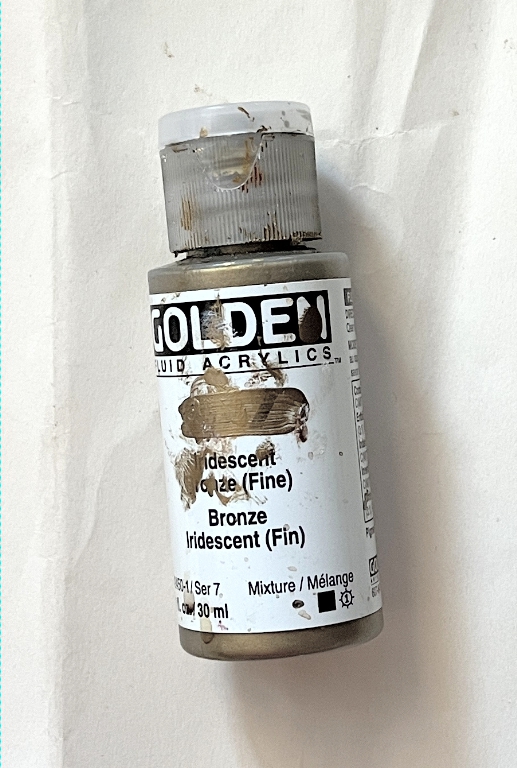
Unfortunately it is only available in this small bottle (30 ml) but a little goes a long way. It is the most like gold leaf that I have come across, and it is very richly pigmented and highly reflective.
Example
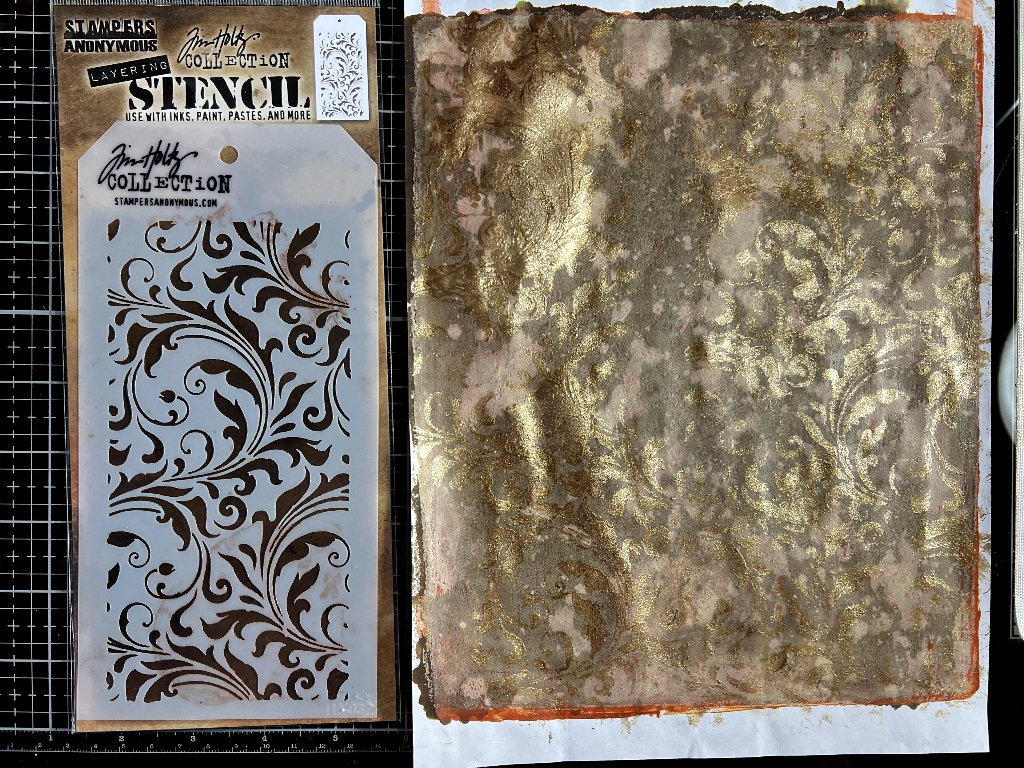
Another stencil onto an “old wall” gel print. In real life this really glows. It is a richer, darker gold than the DecoArt Dazzing Metallic.
Sonnet Decorative Gouache Colours
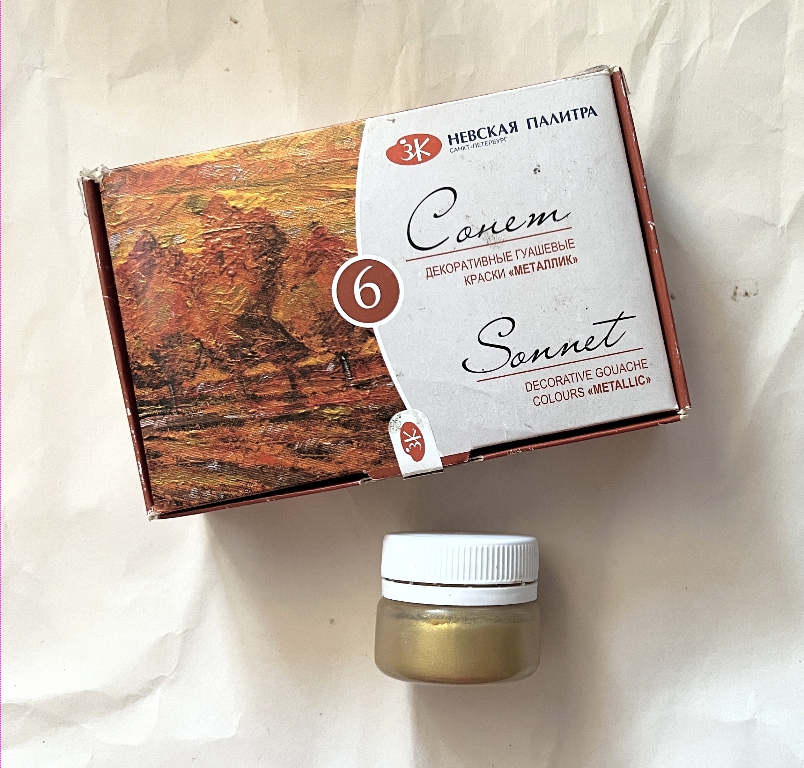
This is one of two golds in a set of six pots of metallic gouache colours from Russia. They behave like any other gouache and are richly pigmented and reflective, but I think the mica flakes are a little larger than in some of the other media because it has a somewhat glittery effect when dry. I do like using this paint, though, and have used it to great effect in some of my Islamic art.
Example
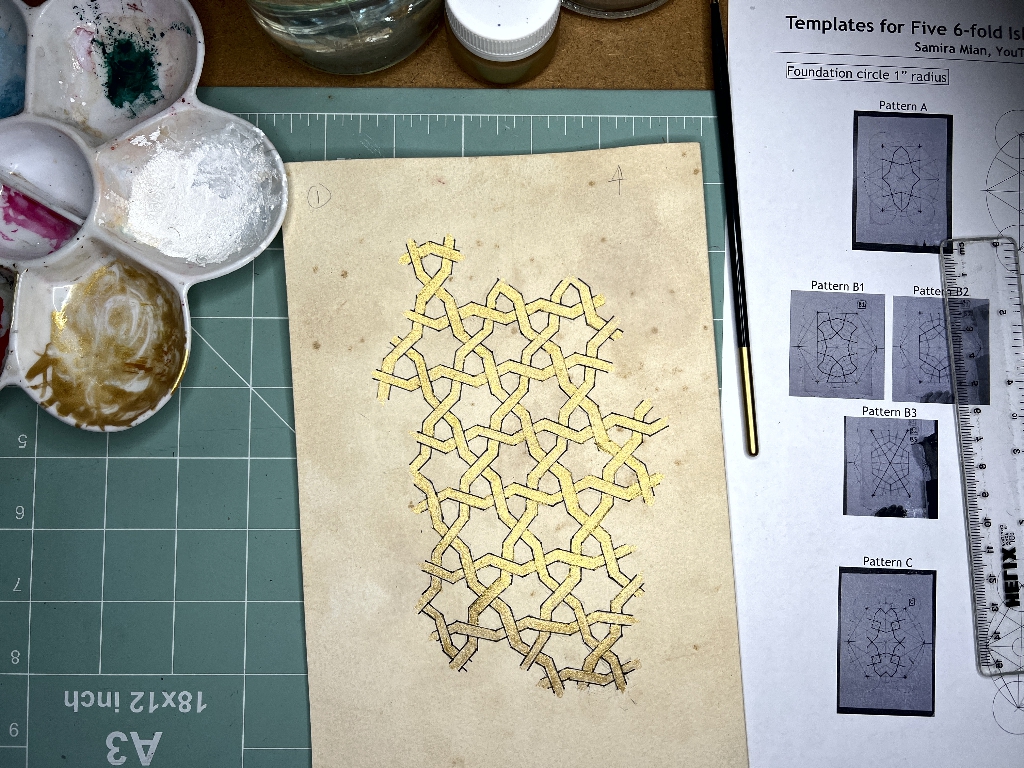
Highlighting with gouache
Some time ago I learnt a good tip from someone online, how to do detailed white highlighting on a project. Many white pens are disappointing in the extreme in my experience – they either won’t write properly, alternating between little flow and great blobs of white that ruin your project, or they reactivate water-based media underneath and lose their brightness which defeats the whole object of using them as a highlighter. This artist recommended white gouache, which is opaque, and I subsequently discovered Dr. Ph. Martin’s Bleed Proof White, which I think is probably a gouache-variant – this stuff is awesome! It is highly opaque and is like a paste in the pot. It can be diluted with water to whatever consistency you want, right down to ink-consistency, for use in calligraphy, without losing opacity. This is the medium I use for the technique.
She used the blender pen from the Tombow Dual Brush Marker range, which contains a colourless fluid. Using the brush tip (rather than the bullet tip at the other end of the pen), you dip just the very tip into the white gouache and apply it gently to your work. Less is more. You can add more as you wish, but once down, it is down. It dries opaque, and stays white, and with this semi-flexible brush tip, you have excellent control and can make the finest lines and marks with it. I tend to wipe the tip gently with a damp piece of kitchen paper before replacing the lid once I have finished, just to make sure it doesn’t dry out. I bought four of these blender pens for highlighting purposes, and labelled them respectively White, Gold, Silver and Bronze, and keep each one exclusively for that pigment.
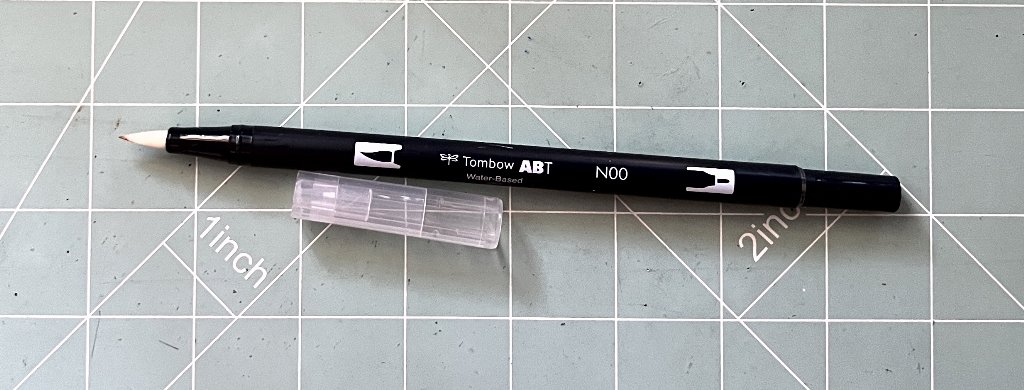
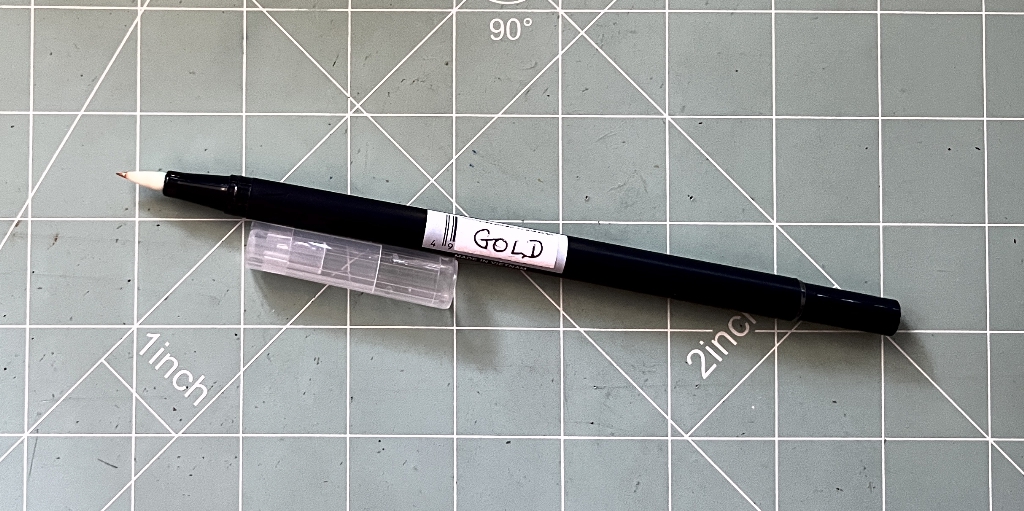
For very fine gold highlighting on a project, this is the way to go. The Russian gold gouache works well with this pen.
Kuretake Gold Mica Ink Paste
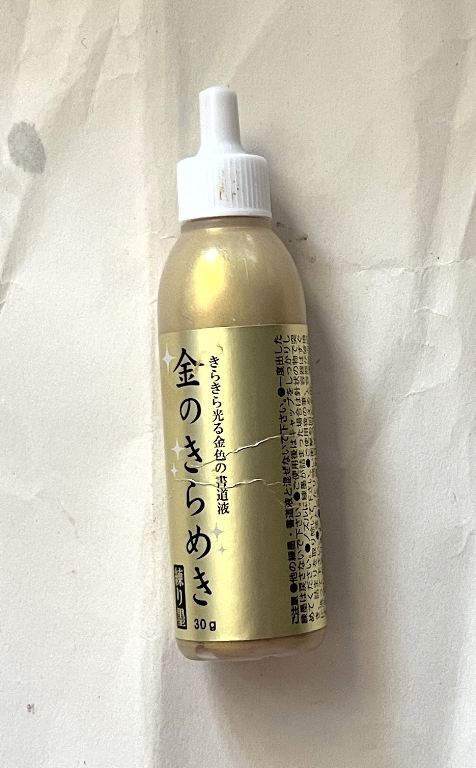
This Japanese medium can be a bit difficult to find but keep searching. It is worth its weight in gold (sorry…). I discovered it through Denise Love and her abstract mixed media work on YouTube. It is fabulous – a thick-ish paste, highly pigmented and reflective, and easy to apply with a brush, for painting or stencilling etc.
Example
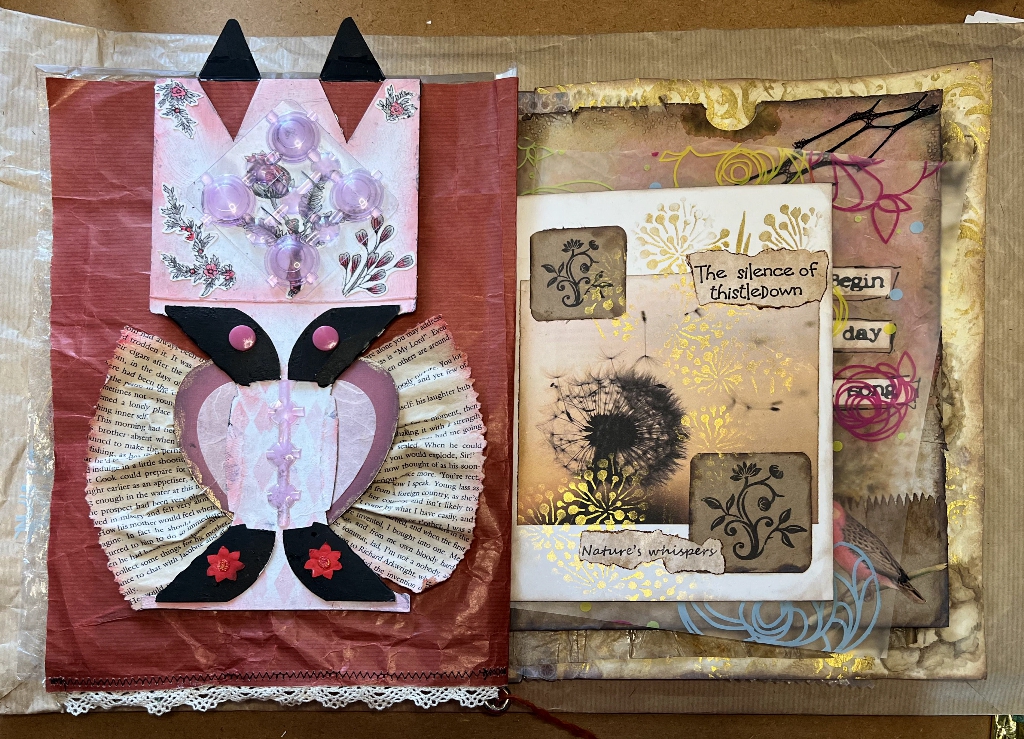
I used this in my “Make a Joyful Noise” album on the right-hand page of this spread, through a stencil. You can see how bright and shiny it is, and how well-defined the stencil outlines are.
Dr. Ph. Martin’s Iridescent Calligraphy Colours – Copper Plate Gold
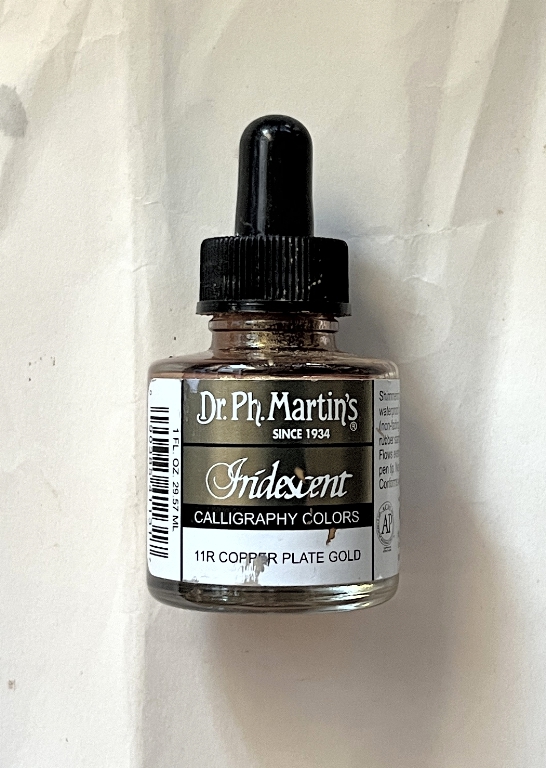
This is a liquid calligraphy ink with a pipette dispenser in the lid. Again, this is highly pigmented. It needs a good shake, and frequent shaking while you are using it.
Examples
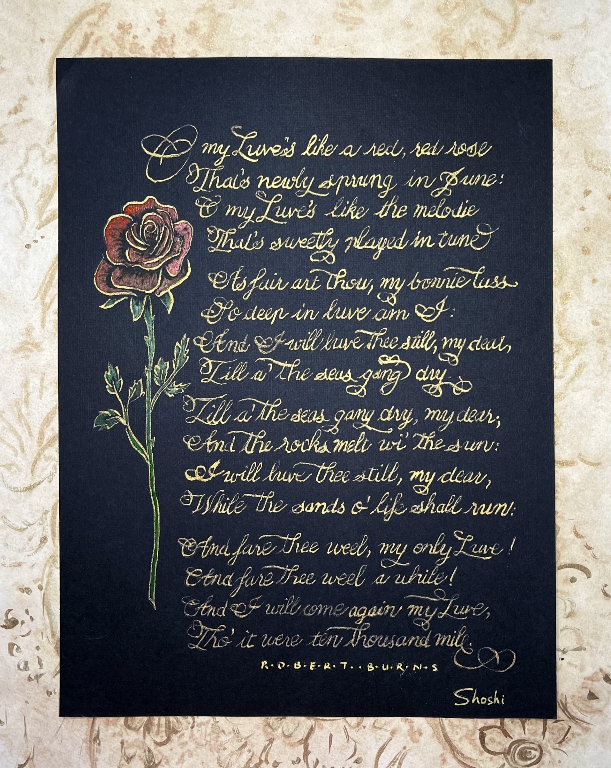
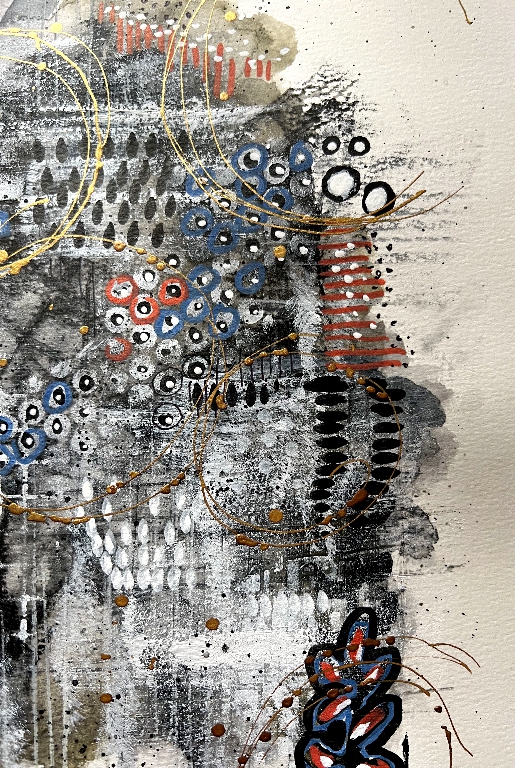
My calligraphy piece on black paper. As with many of the gold media, it works extremely well on dark coloured paper. In the next photo of a detail of an abstract mixed media piece, the circles were done with this ink.
One way to apply very thin lines of gold with ink is with a Fineline bottle.
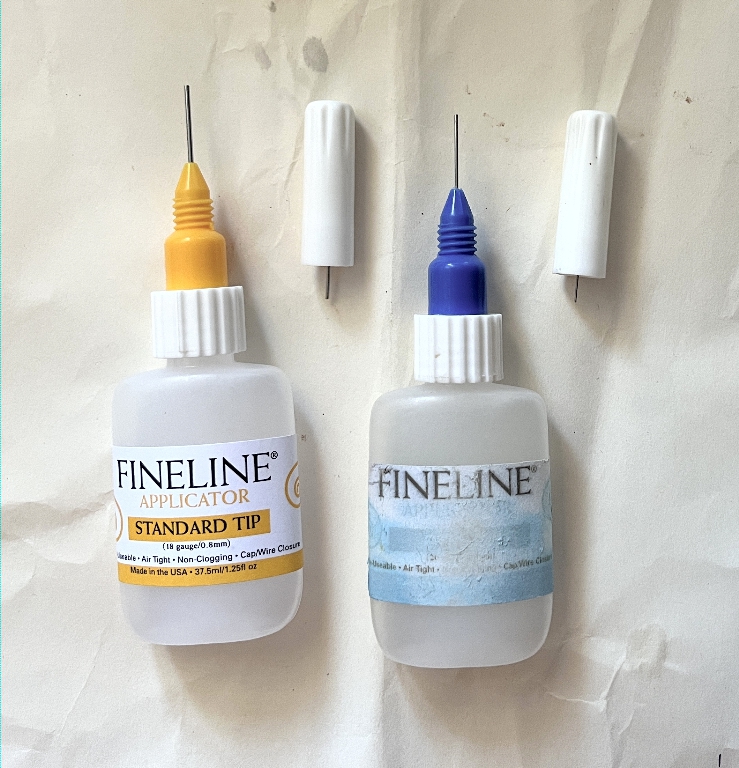
I’m afraid the label on the one on the right has worn off! This is the fine tipped bottle. These bottles are bought empty, to be filled with whatever you like. You can see that the lids have a thin wire attached, which goes down inside the tip of the bottle, to prevent media from clogging the fine tube. You can use them for glue or any medium where you want to apply a fine line. I find that when using a very fluid medium like the gold ink, it is best to hold the tip of the bottle at a flat angle against the paper to prevent too much coming out at once and making a blob. I have some watercolour masking fluid in one of the standard tip bottles, which makes it very much easier to apply.
Posca Metallic Pen – Gold – 0.7 mm
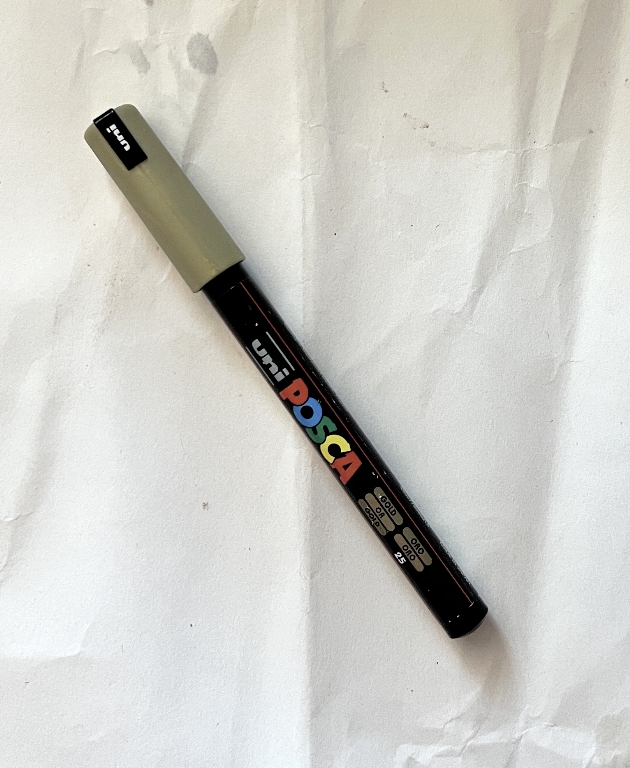
This is an acrylic marker pen and the gold is pretty good. The tip is reasonably fine and the pigmentation and reflective quality is good. It’s a useful tool. This is another one that needs good shaking, with a mixing ball in the barrel. Posca acrylic markers are extremely good and rarely blob, with good flow. There are lots of colours available apart from metallics, and different widths of tip.
Example
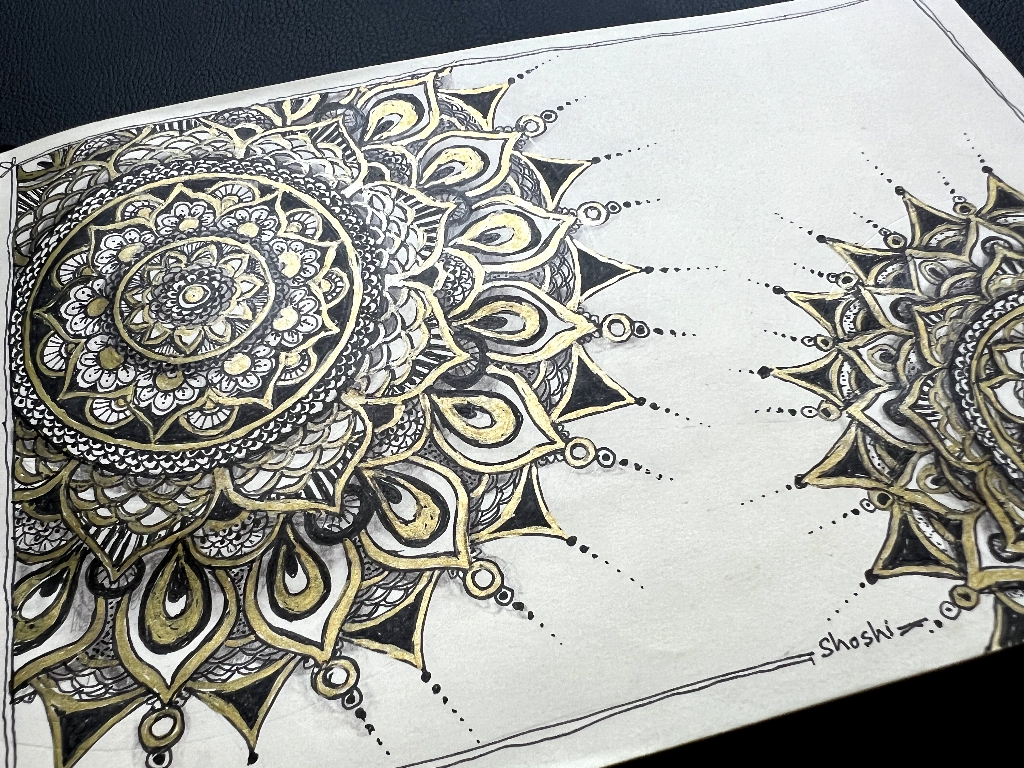
Some black and gold 3-D mandalas that I drew in my ink-pen small Rhodia drawing book. The photo was taken at an angle to show the shine of the gold.
Sharpie Metallic Gold Pen
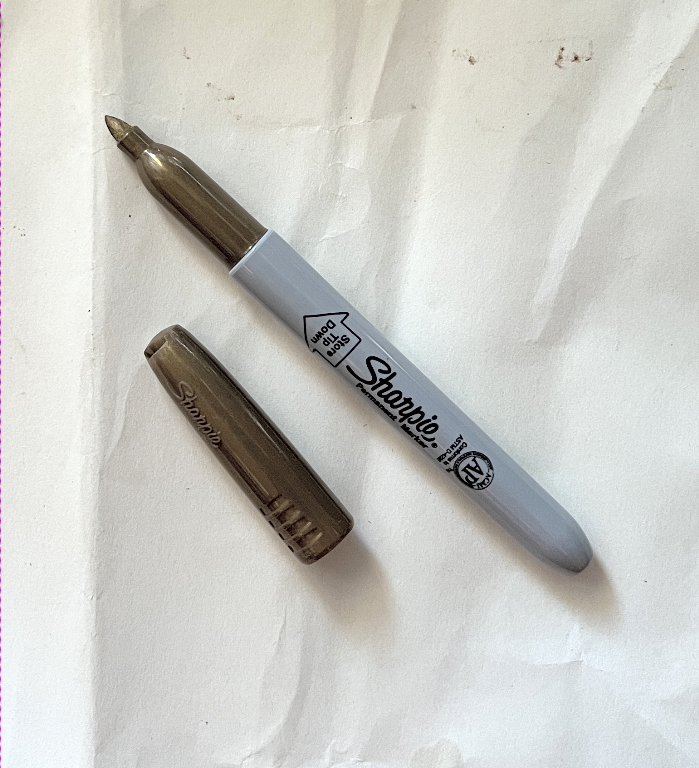
I photographed this with the cap removed because there doesn’t seem to be any indication on the barrel of the width of the tip. It isn’t that fine. This is an OK marker pen if you want a suggestion of gold without the intensity of some of the other examples I have given. I couldn’t find an example of where I had used it.
Artistro Dual-Tip Marker (5 mm & 1 mm)
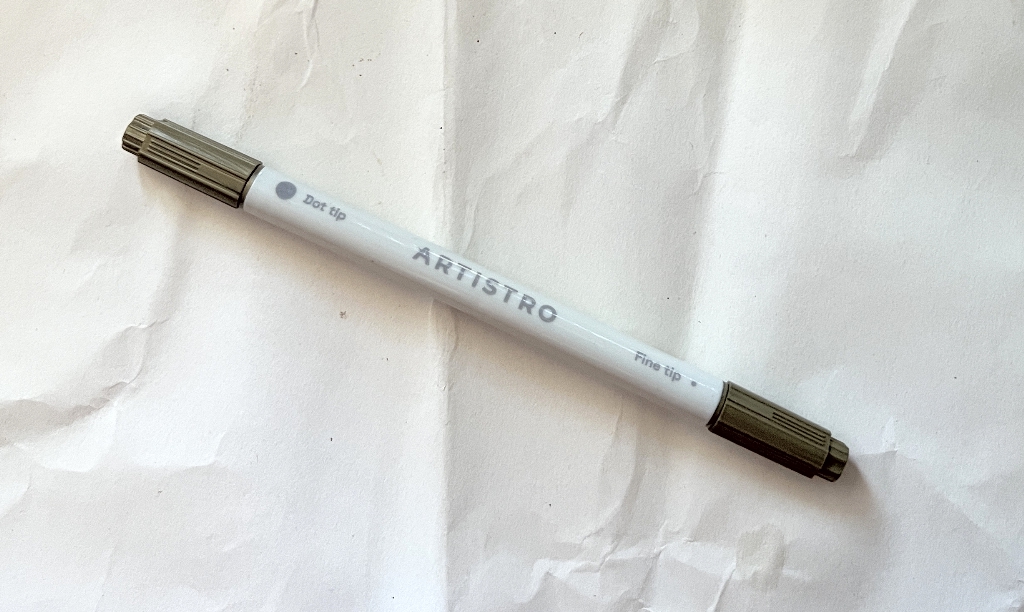
I think this is my favourite gold marker pen. It is a water-based pen, and came in a dual pack with a silver pen, which isn’t half as good as the gold. It is a nice rich gold with good reflectivity, and the 1 mm tip is great for outlining. You can use this for dot art – both tips make great perfect circles! I also have some white ones from this range, which are also very good white marker pens compared with some others but being water-based, they will pick up any unprotected colour from water-based media underneath.
Example
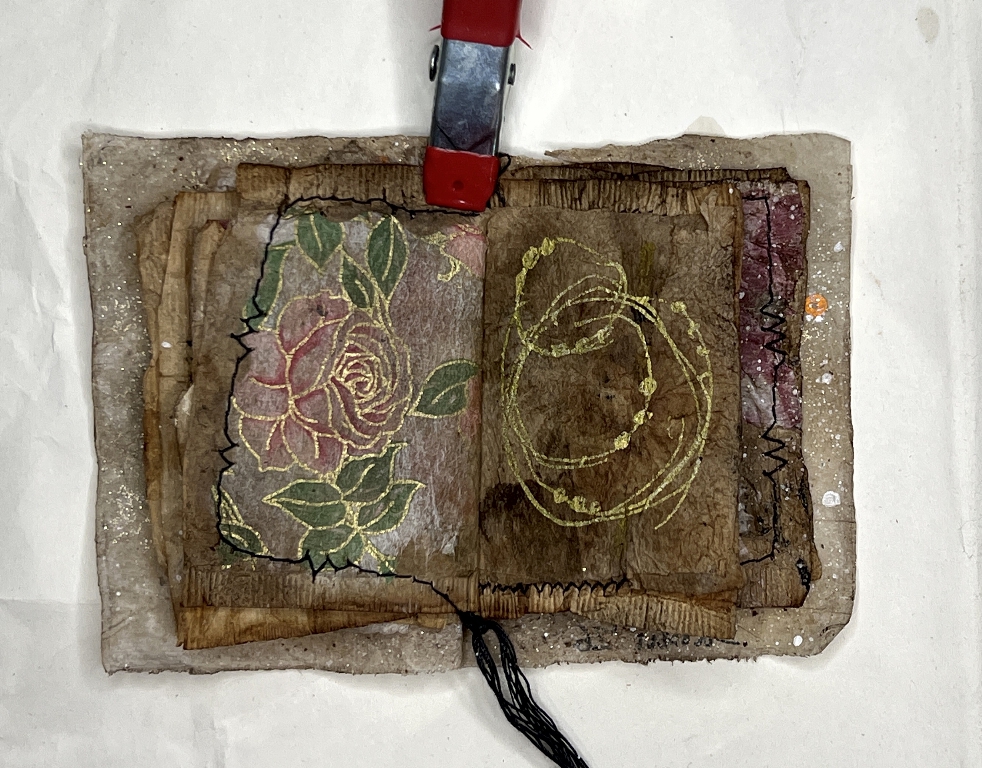
The doodled circles on the right-hand page of this spread in my recent Little Tea Bag Book, to complement the printed gold outlines on the rose on the opposite page (collaged rice paper). You have great control over this pen, good flow and a nice bright gold.
Perfect Pearls
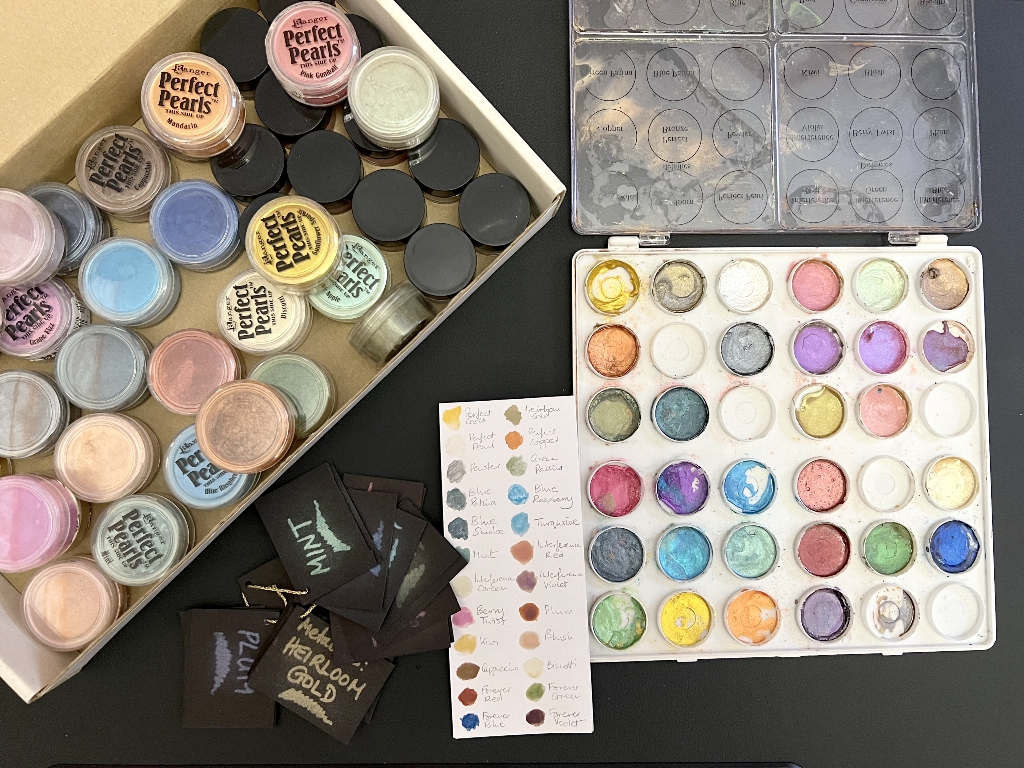
I didn’t remember to swatch these on the above list. These are little pots of shimmery goodness – mica powder – so versatile and absolutely beautiful, with a large range of colours. Many of the colours are dichroic, which means they show a different colour depending on the direction of the light.
Each one has a gum Arabic binder which means that when you apply them with water, they will not rub off when dry. You can dip a wet brush into the powder and paint with it. You can stamp with an embossing ink (or draw or write with an embossing ink pen) – clear sticky fluid – and brush on some powder with a soft brush, gently brushing away anything that doesn’t stick down to the embossing ink. A very light fine spritz of water will fix them. This looks awesome on black paper. In the above photo you can see my little bundle of swatches.
You can also put a little of the powder in water in a spray bottle and make your own shimmer mist.
Following instructions online, I put a little of each colour into an empty palette, added a few drops of water to each, mixed it in and left it to dry. Ready-made watercolour palette to paint with as normal. The golds go on really shiny.
Examples
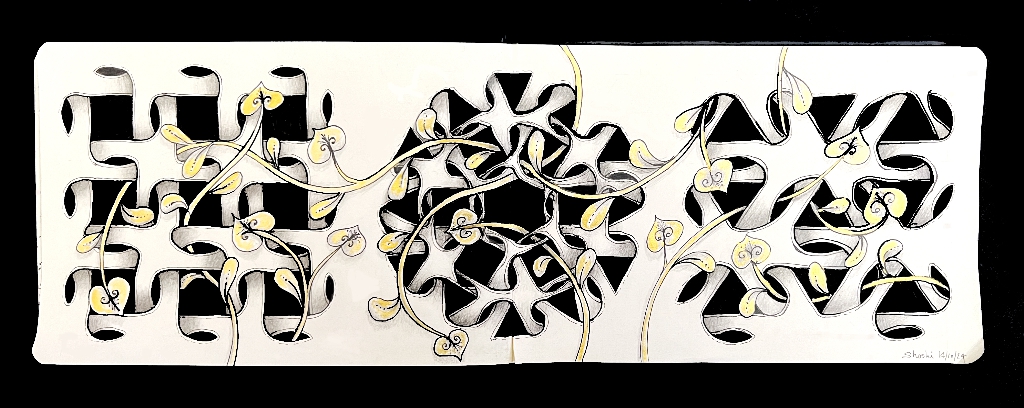
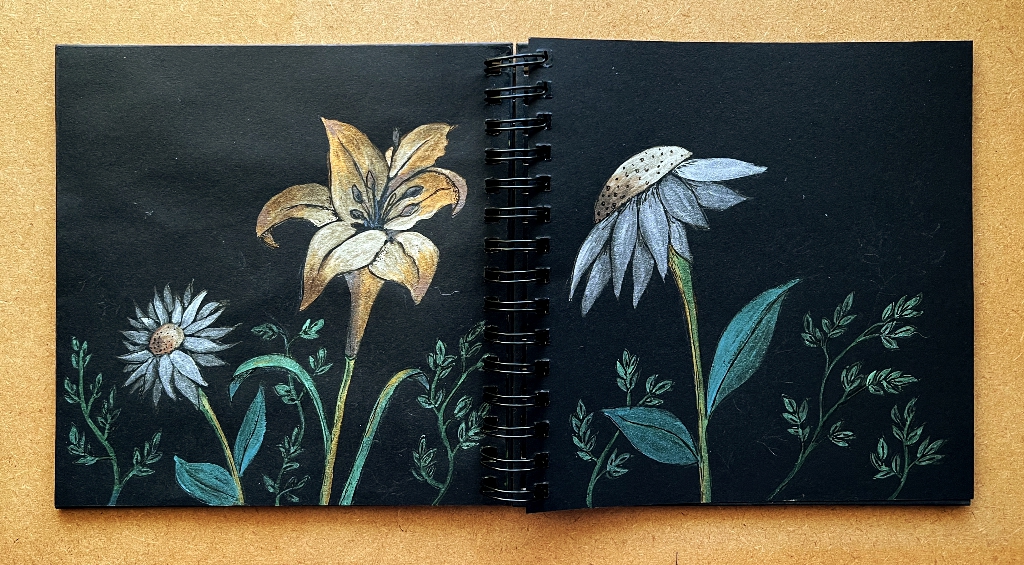
A Zentangle drawing with vines in gold intertwining the trellis. Placed on a black background the paper looks genuinely pierced.
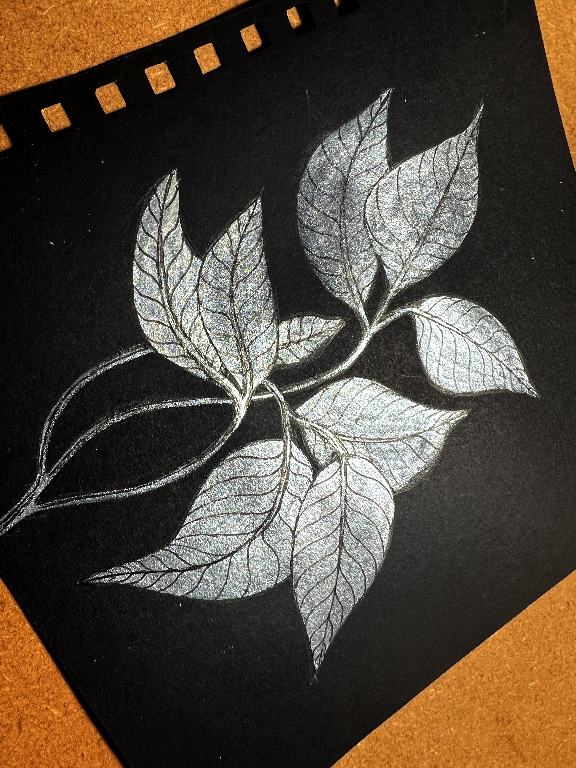
Here are a couple of examples of paintings I did on black paper. No specific examples of gold, but one in silver, and you can see how the other colours work together. They are so shimmery that I make no apology for including them in a post about gold.
Gilding wax
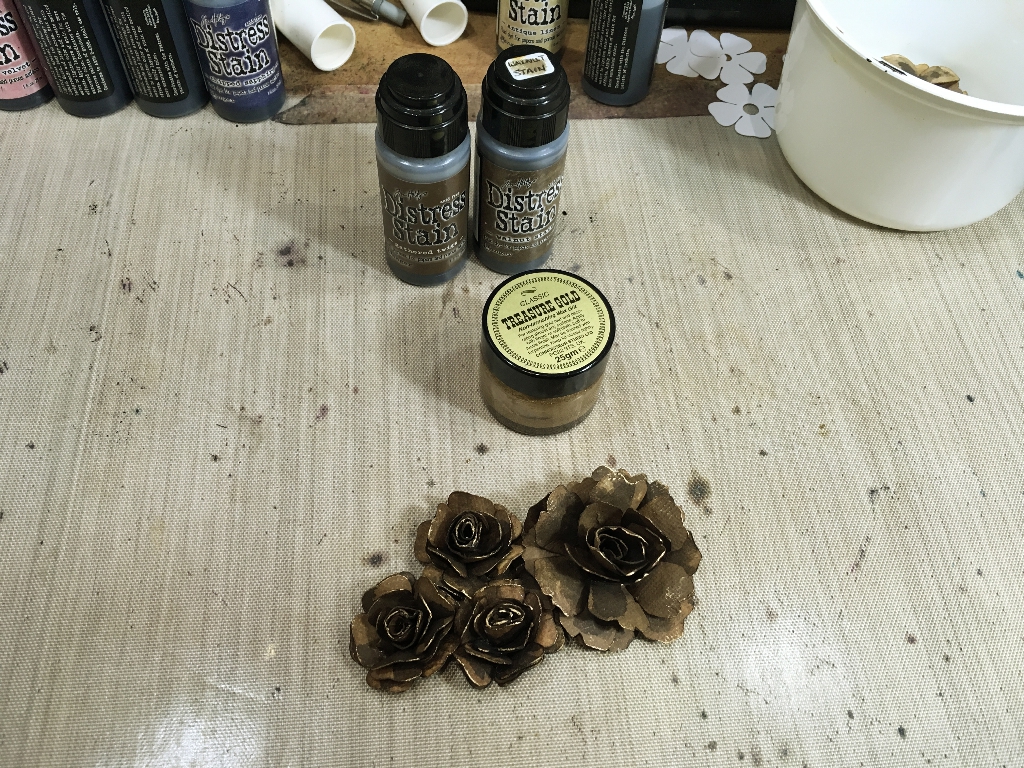
Gilding wax comes in a small pot or tube, and is a solvent-based metallic wax available in different colours. I have silver, gold and copper. You apply it with a fingertip or a brush. It will smudge until dried. On a larger surface it can be buffed to a smooth bright finish. It is one of my favourite golds.
Examples
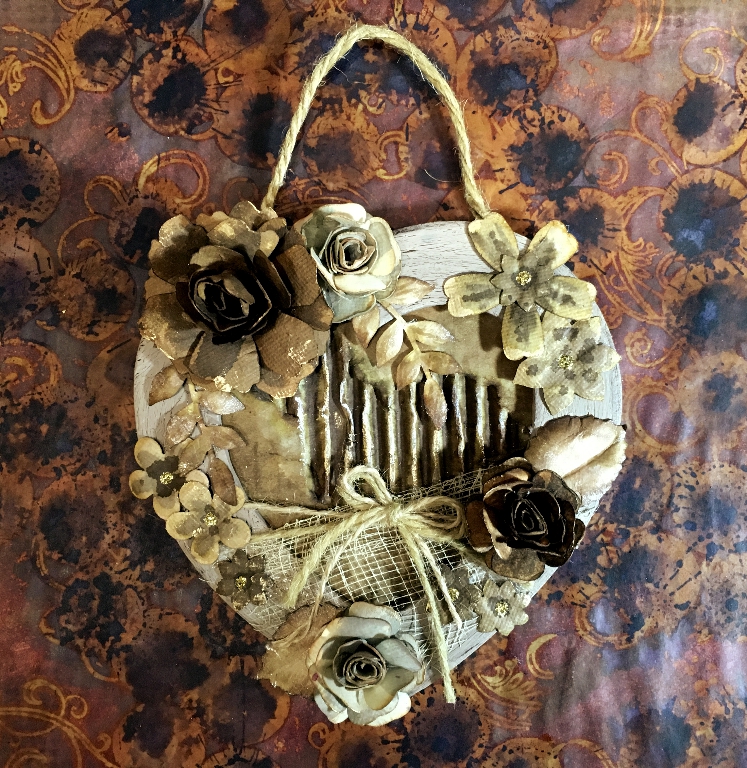
In the above photo, I have lightly applied it to the tips of the brown paper roses I made. In the following photo, I applied it to the raised ridges of corrugated cardboard in the centre of this embellished wooden heart frame that I made as a gift for a friend.
Conclusion
This post has been very long, I’m afraid, but I hope that at the end of it you have some useful information about the many different forms of gold medium available, their different effects and how to apply them. There are probably many more different ones but these are the ones of which I have direct experience over many years. Plenty of choice to get the desired effect in whatever project you are working on! For me, there’s nothing to beat a bit of bling in a project, and nothing to beat pure gold!
On that note, one day I hope to indulge in some shell gold. This is literally pulverised pure gold leaf mixed with gum Arabic, applied with a brush and then burnished to a real, lasting and untarnishable shine with an agate burnisher. This is the preferred medium for embellishing Islamic art. Expensive but unrivalled.